What is a discovery call?
The call before the pitch, what it has to establish, the questions that surface a real problem instead of a symptom, and the one thing every discovery call must end on.
 Toni MedicSalestructSeptember 30, 202612 min readSales Operations
A discovery call is the first real conversation between a seller and a prospect, and its only job is to find out whether there is a problem worth solving before either side spends more time. It is not a pitch, and it is not small talk that happens to come before one. It ends when the seller either has a reason to keep going, or an honest reason to stop.
The short version
- A discovery call's purpose is to qualify and understand a prospect's needs before any pitch happens, per Salesforce's own definition, and Gong's data on 326,000 real sales calls shows the sellers who do this well talk less than average and ask fewer, sharper questions, not more.
- HubSpot's own guide draws the line on length: cold calls run 2 to 10 minutes, discovery calls typically run 20 to 45 minutes. Salesforce's own guidance narrows further by deal type: 20 to 30 minutes for a simple sale, up to an hour across multiple calls for a complex one.
- Across HubSpot's and Salesforce's published frameworks, the questions that matter fall into four jobs: set the stage, qualify budget and authority, find the real cost of the problem, and disqualify fast when the fit is not there.
- A call that ends without a dated next step has not finished. Salesforce's own advice is to leave a full five minutes to set it up, and to book the next meeting on the call itself rather than leaving it to a follow-up email.
- Gong's data shows the biggest gap between winning and losing sellers is not talk time itself, it's consistency: high performers run roughly the same talk ratio whether the deal closes or not, while low performers swing by 10 points, talking more when a deal is already slipping.
How this page was researched
The structure and figures below come from Salesforce's and HubSpot's own published guides to running a discovery call, plus Gong's own analysis of 326,000 recorded sales calls, all fetched and read directly on 29 September 2026 and linked in Sources at the bottom. Salestruct is not affiliated with any of the three and runs discovery calls of its own; the goal here is to state what each source actually publishes, not to promote one vendor's framework over another. Two claims that appear on vendor blogs point to underlying research reports (a Salesforce "State of Sales" report and a 2025 G2 Buyer Behavior Report) that could not be opened and independently verified; both are attributed to the blog that cites them rather than treated as independently confirmed, and are marked as such below.
What is a discovery call?
A discovery call is the first substantive conversation between a salesperson and a prospect, held after initial contact and before any product pitch, with the specific goal of finding out whether the prospect has a real problem the seller can solve and whether the deal is worth pursuing. Salesforce's own guide frames the core task as finding "the root cause" behind a prospect's pain rather than the symptom, and compares it to a dentist visit: a patient shows up with tooth sensitivity, and the real diagnosis, gum disease, only comes out once someone actually examines it. HubSpot's guide distinguishes it directly from the call that usually comes before it: a discovery call is not a cold call. A cold call is a first attempt to get someone on the phone at all; a discovery call happens once that door is already open and its job is to qualify and understand, not to pitch.
Three things are true of a discovery call regardless of whose framework runs it:
- It comes before the pitch, not instead of small talk. The call has a specific diagnostic goal: find the problem, its cost, and who else needs to agree before anything moves forward.
- The seller talks less than the buyer. Gong's analysis of calls that closed versus calls that were lost found closed-won deals averaged 57% seller talk time against 62% on lost deals, a gap that holds even though the difference looks small in isolation.
- It ends on a decision, not a vibe. A discovery call either produces a dated next step or an honest reason the deal should not continue. "It went well" is not an output.
Discovery call vs. cold call
HubSpot's guide sets these two apart mainly by length and by what has already happened before the call starts: "Cold calls usually last 2 to 10 minutes... Discovery calls typically run 20 to 45 minutes." A cold call is an attempt to get attention and secure a next conversation; a prospect on a cold call often does not know why you are calling yet. A discovery call happens after that attention already exists, whether from an inbound inquiry, a referral, or a booked meeting, and the prospect has agreed in advance to talk about their situation. Skipping straight from a cold call into a full discovery agenda, before the prospect has agreed to that scope, is one of the more common ways sellers lose a call early.
Discovery call vs. qualification frameworks like BANT
A discovery call is the conversation. BANT, and heavier frameworks like MEDDPICC, are structures for what to listen for during that conversation and where to record the answer afterward. HubSpot's guide references BANT (Budget, Authority, Need, Timeline) directly as one lens sellers bring into a discovery call. None of these frameworks replace the call itself: they are what a seller checks the transcript against once it is over, and where the answers get filed in the CRM so the next person on the deal does not have to ask again.
How long should a discovery call be?
The two primary sources here agree on the shape and differ on the specifics, because they are answering slightly different questions. HubSpot states discovery calls "typically run 20 to 45 minutes." Salesforce's guide gives a narrower, deal-size-dependent answer: "Keep the calls under 60 minutes, and 30 if you can," suggesting "20 to 30 minutes for a simple, transactional sale, and up to an hour across multiple calls for a complex enterprise sale."
Both sources converge on the same underlying point even where the numbers differ: a discovery call is bounded by how much a prospect will realistically stay engaged for, not by how many questions a seller has prepared. A complex enterprise sale does not get one long call, it gets multiple shorter ones. And in both frameworks, time is not spent evenly: Salesforce's guidance explicitly reserves the last five minutes of the call for confirming what happens next, which is a fixed cost regardless of how the rest of the call goes.
What questions should you ask on a discovery call?
Read across HubSpot's and Salesforce's published question banks, the questions that actually move a discovery call forward fall into four jobs, not one long list. A call that only does the first of these is a friendly chat; a call that jumps straight to the third without doing the first two turns into an interrogation, which is exactly the failure mode Gong's data flags below.
- Set the stage
Confirm what the prospect already knows, why they took the call, and what they are hoping to get out of it. HubSpot's guide frames this as the opening move because it tells the seller how much context-setting is actually needed before qualifying anything. Jen Allen-Knuth, founder of DemandJen, quoted in HubSpot's guide, opens by stating her own research back to the prospect and inviting a correction: "It looks like [company] sells a [product/service] to [stakeholder roles] at [customer verticals]. It seems like the problem you're solving for those customers is X, and the company makes money by XYZ. What did I get wrong?"
- Qualify budget, authority and timeline
Establish whether the prospect can actually buy: is there budget, who else has to sign off, and is there a deadline forcing a decision. This is the BANT layer of the call, and HubSpot's guide frames it as turning assumptions about budget, authority, need and timeline into a clearer sales decision, separating viable opportunities from poor-fit prospects faster.
- Find the cost of not solving the problem
This is the step most calls under-run. Samantha McKenna, founder of #samsales, quoted in HubSpot's guide, pushes past "what do you want" to "why do you want it, and who else does it impact?" Salesforce's guide frames the same idea as turning the problem into a number: ask how the prospect's pain will affect the business "a year from now," not just what the prospect says they want.
- Disqualify, and set a dated next step
A discovery call is allowed to end in "this isn't a fit," and HubSpot's guide includes disqualifying questions as their own category for exactly that reason. Where it is a fit, Salesforce's guide is specific about the close: leave five minutes to agree the next step, name it concretely (a demo, a technical conversation with a broader group, a proposal), and book it on the call rather than by follow-up email.
How much should you talk versus listen on a discovery call?
Gong's own research team analyzed 326,000 sales calls that lasted at least 10 minutes and found the average seller talks 60% of the time and listens 40%. The gap between winning and losing deals is smaller than that headline number suggests, but it moves in a consistent direction: closed-won deals averaged 57% seller talk time, lost deals averaged 62%.
Based on Gong's analysis of 326,000 sales calls of at least 10 minutes, published 2025.
Gong's more useful finding sits underneath that headline number. The single biggest separator between high and low performers was not the ratio itself but how consistent it stayed across outcomes: "High performers maintain roughly the same talk ratio whether they win or lose a deal. Low performers' talk time swings by 10%, from 54% in won deals to 64% in lost deals." In other words, a struggling seller does not just talk more on average, they specifically start talking more once a deal is already going badly, which is close to the opposite of what the call needs at that moment.
Question count follows the same pattern and cuts against the instinct to ask more when a call feels stuck. Gong found "sellers who won deals asked 15 to 16 questions in their calls, while sellers who lost deals asked more questions, about 20 per call." Gong's own read on this: "more questions don't always lead to better conversations," and a higher count more often signals an interrogation-style call than a well-run one.
Closed-won sellers do not out-talk the room. They ask fewer, sharper questions and let the buyer fill the rest of the time.
What should a discovery call end on?
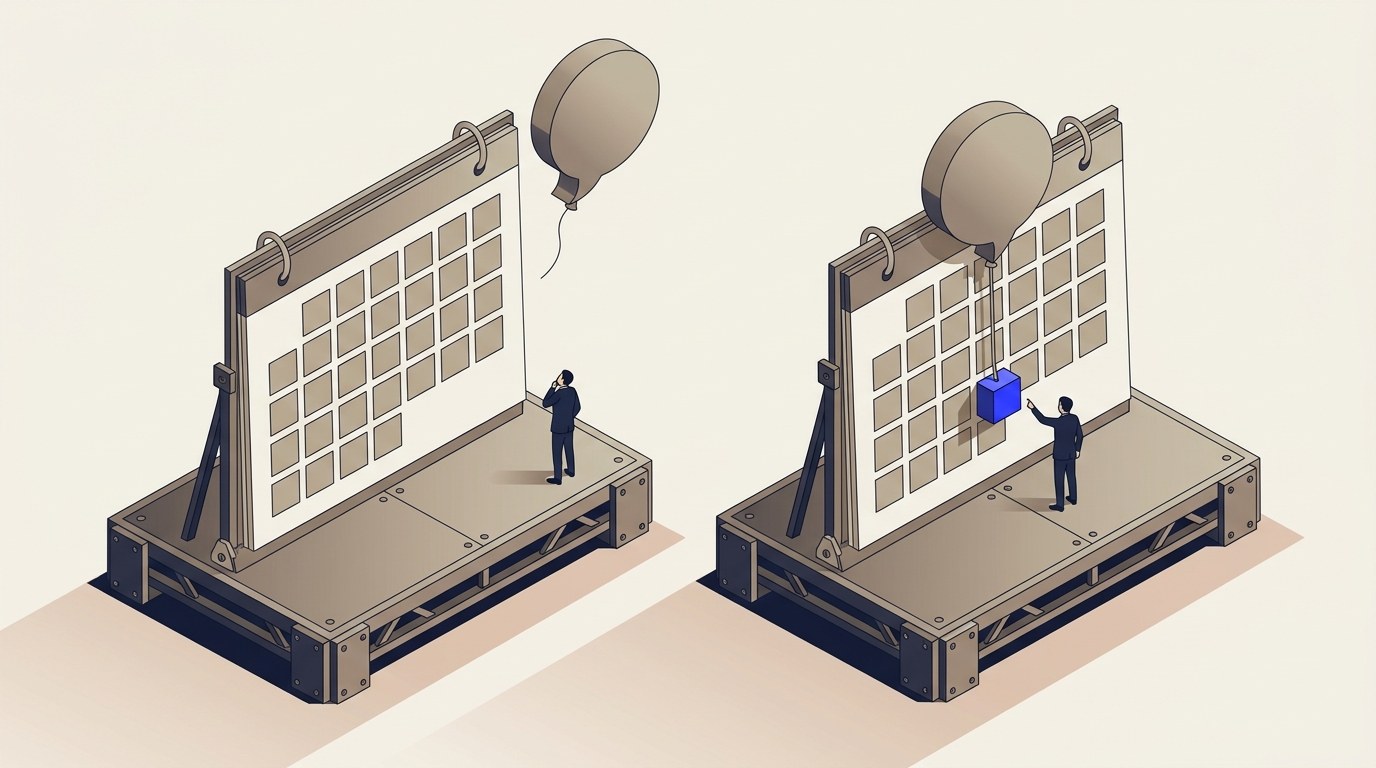
Both primary sources are specific here, and they agree: a discovery call is not finished when the questions run out, it is finished when there is a dated next step both sides have agreed to. Salesforce's guide states it as a hard rule: "leave a full five minutes at the end to properly set up the next step," naming a demo, a technical conversation with a broader group, or a follow-up packet of materials as the common options, and adding a specific tactic: "if your next step involves a meeting, try to schedule it right there and then" rather than leaving it to a follow-up email that may not get answered.
This is the same discipline that shows up in how a sales pipeline is supposed to work: a stage exists to record evidence, not effort, and "we had a good call" is not evidence a deal moved forward. A discovery call that ends without a dated commitment has produced a stage change with nothing behind it, which is exactly the kind of pipeline entry that looks active on a dashboard and is actually stalled.
Common ways a discovery call ends without actually finishing:
- "I'll follow up by email." Salesforce's guidance is explicit that a meeting should be booked on the call itself, not deferred to a message the prospect may not open.
- No named next action. "Let's stay in touch" is not a next step. A demo, a call with a named additional stakeholder, or a specific document to review each are.
- The five minutes get cut for time. If the call runs long on qualification, the close is the wrong place to save time, because it is the one part of the call that determines whether anything happens next.
- The next step has no date attached. A next step without a date on the calendar behaves the same as no next step at all once the call ends and other priorities take over.
Frequently confused terms
| Term | What it actually is |
|---|---|
| Discovery call | The first substantive qualifying conversation, typically 20 to 45 minutes, before any pitch. |
| Cold call | A short (2 to 10 minute) first attempt to get a prospect's attention and secure the discovery call. |
| Qualification framework (BANT, MEDDPICC) | A structure for what to listen for during discovery and where to record the answer, not a call format itself. See BANT vs. MEDDIC vs. MEDDPICC. |
| Demo call | The pitch-stage call that follows discovery once a real problem and a plausible fit have been established. |
| Talk-to-listen ratio | The share of a call's time the seller spends speaking versus the prospect, measured by conversation-intelligence tools like Gong. |
Sources
Salesforce, What Is a Discovery Call? [+ Tips for a Successful One] (2023)
HubSpot, Discovery Call Questions That Reveal Real Pain Points (2026)
Gong, Mastering the talk-to-listen ratio in sales calls (2025)
How these were checked
Salesforce's article (Marcus Chan, published 11 October 2023) and HubSpot's guide (Dan Tyre, last updated 30 July 2026) were both fetched and read in full on 29 September 2026; all quotes above are their own wording. Salesforce's blog cites an internal "State of Sales" report for the claim that "87% of business buyers expect sales reps to act as trusted advisors"; that report's own PDF could not be opened for independent verification, so the figure is not repeated above as a confirmed statistic and is omitted rather than restated on the strength of the blog post alone. HubSpot's guide separately cites a "2025 G2 Buyer Behavior Report" for a claim that 62% of buyers prefer engaging sales reps later in the buying journey; that report was not independently located and opened either, so it is likewise not repeated here. Gong's article (Dan Morgese, originally authored by Chris Orlob in 2016, updated with new data on 20 March 2025, page metadata shows "last modified" 4 March 2026) is based on Gong's own stated dataset of 326,000 sales calls of at least 10 minutes; the underlying dataset itself was not independently reviewed, only Gong's own published summary of it. No client data or Salestruct case data appears in this article.
Common questions
If you want a second pair of eyes on your own setup, Salestruct runs a free diagnostic.
Read next.
All articlesWhat is MEDDPICC? Each letter, with example questions
Eight letters, eight questions to ask a real deal, and the CRM field each answer belongs in. Plus the court case that just settled who owns the term.
What is a sales pipeline? Stages, metrics and reviews
The stages a deal moves through, the numbers that come off it, and how to review it without leaning on a coverage rule nobody can source.