Attio vs HubSpot: which CRM fits a sales team that wants to build its own?
One is a young, configurable CRM built around a flexible data model. The other is a nine hub platform with a much longer track record. Here is what each one's own documents say, feature by feature.
 Toni MedicSalestructSeptember 30, 202616 min readCRM & Pipeline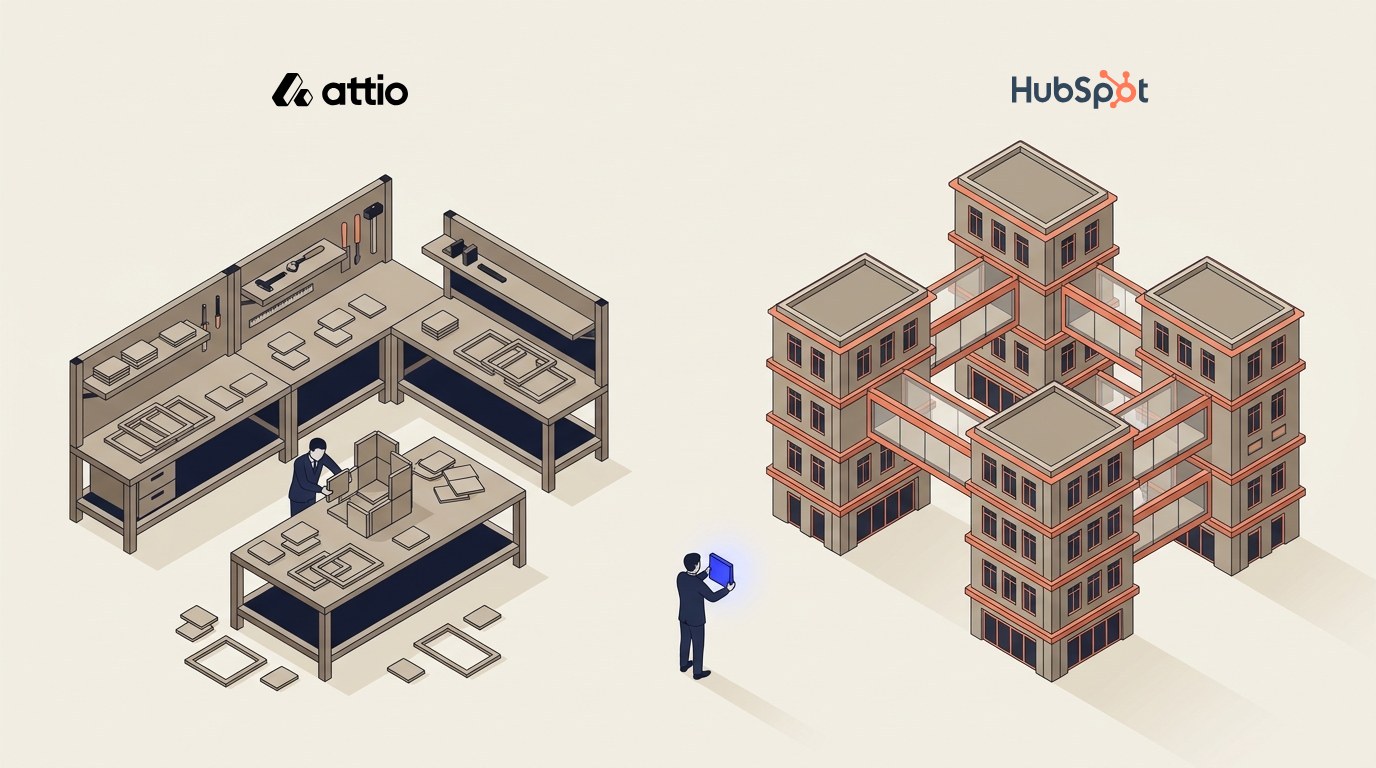
The short version
- Attio's paid plans run €31 to €74 a seat a month on annual billing, with no onboarding fee. HubSpot's Sales Hub runs €7 (shown, list €20) to €150 a seat, and Professional and Enterprise add a required one-time onboarding fee of €1,470 or €3,420.
- Attio's core is a small number of connected objects (up to 12 on Pro, unlimited on Enterprise) a team configures itself. HubSpot ships a much larger pre-built structure across nine hubs, with custom objects reserved for Enterprise.
- Attio signs its webhooks with HMAC-SHA256 and publishes the full retry policy: up to 10 attempts over about 3 days, a 5-second delivery timeout, then the webhook is marked degraded and you get an email. HubSpot signs its webhooks too, but doesn't publish a retry policy.
- Attio states directly that its Sequences feature is not built for cold or high-volume outreach, and that it is "not an email service provider," sending everything through your own synced Gmail or Microsoft account. HubSpot's sequences run up to 500 to 1,000 emails per user per day depending on plan, with LinkedIn actions requiring a separate Sales Navigator subscription.
- HubSpot is the more mature product by every public signal available: founded 2006, 9,000+ employees, 306,000 customers, "over 2,000" listed integrations. Attio doesn't publish a founding date or team size; its own funding announcements put it at $116 million raised across a Seed, Series A, and a $52 million Series B led by GV.
How this comparison was made
- Every price, limit and feature below comes from Attio's or HubSpot's own pricing page, help center, developer documentation, or app store listing, read directly on 29 September 2026 and linked in the Sources section.
- Where a number wasn't published (Attio's team size, its total integration count, HubSpot's webhook retry policy), the table says so rather than guessing.
- Prices shown are in EUR, the currency both sites displayed to a visitor browsing from the EU, and exclude VAT. Figures change; if a number here disagrees with the vendor's page on the day you read it, the vendor's page is right.
- Neither product was tested inside a live account for this piece. Everything below is what each company publishes about its own product.
- Attio and HubSpot logos are the property of their respective owners and are shown here for identification only. Salestruct has no commercial relationship with either company.
What is the difference between Attio and HubSpot?
Attio is built around a small, generic data model: Objects, Records, Attributes, Lists and Entries. A team decides what an "object" is (a company, a deal, an investor, a candidate) and connects them with custom attributes, rather than working inside a fixed set of sales-shaped fields. Attio doesn't publish a founding year or headcount on its own site (its /manifesto and /company pages return nothing), but its about page confirms "190+ team members" across "London, and across Europe and the US," and its own blog records a funding history from a Seed round in November 2021 through a $52 million Series B led by GV, for $116 million raised to date.
HubSpot describes itself as founded in 2006, with 9,000+ employees and 306,000 customers, and sells nine connected "hubs" (Marketing, Sales, Service, Content, Operations, Commerce, and Data among them) that share one contact and company database. The comparison in this post is scoped to the Sales Hub, since that's the product a sales team would actually put next to Attio, but several rows below note where a capability actually lives in a different hub.
The practical difference: Attio hands you a smaller number of building blocks and expects you to assemble them. HubSpot hands you a much larger, mostly pre-built structure, and charges more to unlock the parts of it that behave like Attio's flexibility (custom objects, advanced permissions, deeper automation).
What do Attio and HubSpot cost per seat?
Plans and prices
Checked 29 September 2026

Free plan
Edge: Even
Up to 3 seats. Real-time contact syncing, automatic data enrichmentUp to 2 usersEntry paid tier, annual billing
Edge: HubSpot
Plus: €31/seat/month (€39 monthly). Up to 10 seats, private lists, enhanced email sendingStarter: €7/seat/month shown (list €20). Restricted workflows, up to 15 pipelinesMid paid tier, annual billing
Edge: Attio
Pro: €74/seat/month (€93 monthly). Unlimited seats, Call Intelligence, sequences, permission controls, advanced reportingProfessional: €90/seat/month, plus a required €1,470 one-time onboarding feeTop tier
Edge: Attio
Enterprise: custom quote, billed annually. Unlimited objects, unlimited teams, security and admin controlsEnterprise: €150/seat/month, plus a required €3,420 one-time onboarding feeOnboarding fee
Edge: Attio
None published on any tier€1,470 (Professional) or €3,420 (Enterprise), required, one-timeAI usage
Edge: Even
Seat credits (100 to 2,500/seat/month) plus workspace credits (250 to 10,000/month); more can be bought from €70/monthCredits (500 to 5,000/month) for AI features, billed at $0.010 per extra credit; unused credits don’t roll overRead from: Attio pricing (EUR) · HubSpot Sales Hub pricing (EUR).
Tiers above are paired by what each one actually includes, not by list price: Attio Plus sits closer to HubSpot Starter (small teams, basic sending), Attio Pro sits against HubSpot Professional (sequences or workflows, permissions, advanced reporting), and both Enterprise tiers are the security-and-scale tier. HubSpot's discounted €7 Starter price has no published end date or renewal term on its own pricing page, so the €20 list price is the safer number to plan around.
Year-one cost, annual billing, 10 seats
Licences, 12 monthsRequired one-time onboarding fee
Entry tier
Attio Plus vs HubSpot Starter
Attio Plus, 10 seats€NaNHubSpot Starter, 10 seats (shown price)€NaNMid tier
Attio Pro vs HubSpot Professional
Attio Pro, 10 seats€NaNHubSpot Professional, 10 seats€NaNHubSpot's Starter row uses the discounted price shown on its pricing page, which carries no published expiry. At the list price of €20/seat/month, 10 Starter seats run €2,400 a year, still cheaper than Attio Plus. Neither vendor's own site converts these to USD for an EU visitor.
Read from: Attio pricing (EUR) · HubSpot Sales Hub pricing (EUR).
Three pricing details the comparison pages don't usually mention:
- Attio charges no onboarding fee on any published tier. HubSpot requires one on Professional and Enterprise, and doesn't offer a way to waive it on its pricing page.
- Attio's AI and enrichment usage is metered by credits at both the seat and workspace level, and extra workspace credits are sold in fixed blocks (5,000 credits for €70/month on annual billing, up to 50,000 for €410/month). HubSpot's credits are pooled per account with no published per-block price beyond the flat $0.010 rate.
- Attio's Free plan caps at 3 seats; HubSpot's caps at 2. Neither is built for a team past a handful of people.
Which one has the more flexible data model?
Data model and objects
Checked 29 September 2026Objects on entry tier
Edge: Even
Up to 3 (Free), up to 5 (Plus)Standard objects only (contacts, companies, deals, tickets)Objects on mid tier
Edge: Attio
Up to 12 (Pro), standard and custom combinedStandard objects only. Custom objects are Enterprise onlyObjects on top tier
Edge: Attio
Unlimited (Enterprise)Up to 10 custom object definitions, 1,000,000 records each (Enterprise)Records
Edge: Depends on your setup
50,000 (Free) to 1,000,000 (Pro), custom on Enterprise1,000,000 records per custom object on EnterpriseCustom relationship attributes and formula attributes
Edge: Even
Formula attributes and record templates: Plus and aboveCustom properties on every paid tier; calculated properties availableFile storage
Edge: Depends on your setup
50 GB (Free, Plus) to unlimited (Pro, Enterprise)Not published in the comparison sources for this reviewRead from: Attio pricing (EUR) · Attio: Understanding objects · HubSpot Product & Services Catalog.
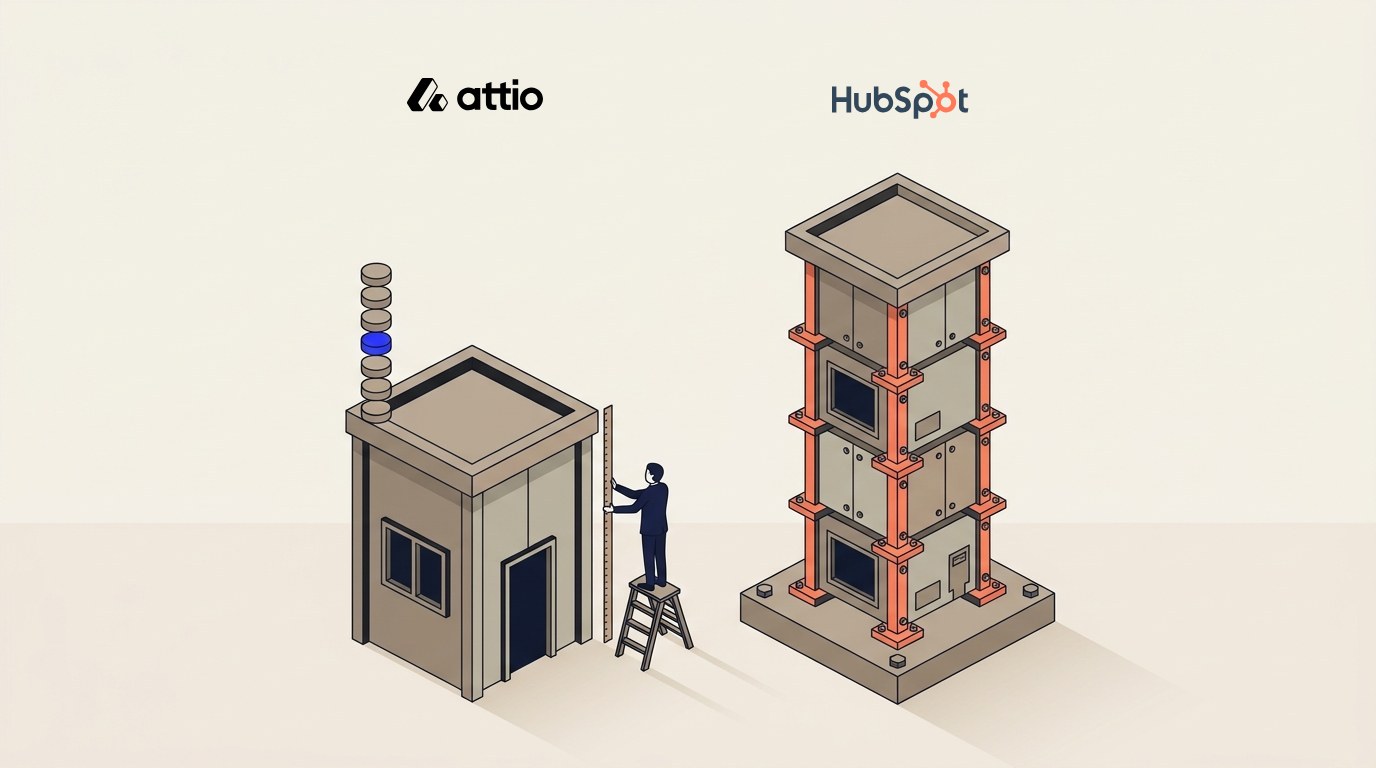
The difference in philosophy is clearest here. Attio treats custom objects as a Pro-and-above feature that most teams can reach without an enterprise contract, capped at 12 combined objects on Pro and unlimited on Enterprise. HubSpot keeps custom objects behind Enterprise entirely, so a HubSpot team modeling anything beyond contacts, companies, deals and tickets (a piece of equipment, a partner account, a property listing) needs the top tier no matter its size.
Neither company publishes a side-by-side custom-field cap the way Pipedrive does, so a team that needs a specific number should check both vendors' current attribute limits directly before committing to a year.
Which one is easier to run, day to day?
Interface and mobile
Checked 29 September 2026iOS app rating
Edge: HubSpot
3.6 out of 5 (28 ratings)4.7 (~15,700 ratings)Android app rating
Edge: HubSpot
3.3 stars (20 reviews), 5K+ installs4.6 (~13,500 reviews), 1M+ installsPrimary view
Edge: Even
Configurable list and record views built on the Objects/Lists modelPipeline board, or a record-centric view depending on hubAsk Attio / in-app AI
Edge: Even
Ask Attio: natural-language queries and workflow generation, all plansBreeze AI agents, metered by creditsRead from: Attio iOS app listing · Attio Android app listing · HubSpot iOS app listing · HubSpot Android app listing.
The app store numbers say something a features table can't: HubSpot's mobile app has been rated by roughly 15,700 iOS users and installed over a million times on Android, against Attio's 28 iOS ratings and 5,000-plus Android installs. That's not a verdict on either app's quality, it's a scale gap that comes from HubSpot having been on the market since 2006 against Attio's much shorter public history, and it matters if your reps live on their phone between meetings.
Which one automates more, and where does that automation stop?
Workflows, automation and outreach
Checked 29 September 2026Automation builder
Edge: Even
Workflows: trigger plus steps, built on a visual canvas or generated from a plain-language prompt via Ask AttioWorkflows: up to 50 (Starter, restricted) to 1,000 (Enterprise), fully customizable from ProfessionalCode or custom logic in an automation
Edge: HubSpot
Integration blocks (Pro and Enterprise); no general-purpose code step publishedCustom code actions, documented in the developer API referenceEmail sequences
Edge: HubSpot
Pro and Enterprise only. Sent through your synced Gmail or Microsoft account, explicitly not built for cold or high-volume outreachUp to 500 (Professional) to 1,000 (Enterprise) email sends per user per day. LinkedIn actions require a Sales Navigator subscriptionSending limits on sequences
Edge: HubSpot
Governed by your own email account’s limits, not a published Attio cap500 to 1,000 emails/user/day, published directly on the pricing pageAI inside automations
Edge: Even
Ask Attio generates workflows from natural language; Custom Agents and a Web Agent are separate AI featuresAI assistants can be added as workflow actions, metered by creditsRead from: Attio: Introduction to workflows · Attio: Create a sequence · HubSpot: Create workflows · HubSpot Sales Hub pricing (sequence limits).
The most useful line in Attio's own documentation, for the audience this post is written for, is a plain statement of what Sequences are not for: "Cold or high volume sales outreach" is listed as an example of a use case where Attio's own sequence feature "should not be used," alongside "Email marketing." Attio isn't an email service provider, and every sequence email goes out through the seat holder's own synced Gmail or Microsoft account, so the practical sending ceiling is whatever that mailbox provider allows, not a number Attio publishes. HubSpot, by contrast, prints its own per-user daily sending caps (500 on Professional, 1,000 on Enterprise) directly on its pricing page.
If your team's automation need is "run our outbound sequences inside the CRM," that's a HubSpot column, not an Attio one, on the evidence both companies publish about their own products.
How do the two handle webhooks?
Webhooks
Checked 29 September 2026Signing method
Edge: Even
HMAC-SHA256 of the raw request body, sent in an Attio-Signature header (duplicated as X-Attio-Signature)Signature versions v1 to v3, documented in the developer API referenceDelivery guarantee
Edge: Attio
At-least-once, with an Idempotency-Key header shared between retries and redeliveriesNot detailed in the sources reviewed for this pieceRetry policy
Edge: Attio
Up to 10 attempts with exponential back-off over about 3 days, then the webhook is marked "degraded" and an email is sentNot publishedDelivery timeout
Edge: Attio
5 seconds; a slower response counts as a failureNot publishedTransport requirement
Edge: Even
HTTPS onlyNot detailed in the sources reviewed for this pieceDuplicate subscriptions
Edge: Attio
Rejected with a 409 if the target URL, event type and filter already match an existing webhookNot detailed in the sources reviewed for this pieceDelivery rate limit
Edge: Even
25 requests per second, per target URLGoverned by the same tiered API limits as other requestsRead from: Attio: Configuring webhooks · HubSpot: Validating requests (webhook signatures v1 to v3) · HubSpot: Use webhooks with workflows.
Attio's own developer documentation is unusually specific here, and it's worth quoting rather than paraphrasing: a failed delivery is retried "up to 10 times with an exponential back-off, which will happen over approximately 3 days in total; after which, the webhook will be marked as degraded and we'll send you an email." HubSpot signs its webhook payloads too, but its published developer docs for this review didn't include an equivalent retry-count or timeout figure, so that row is marked not published rather than assumed to be the same or absent.
Which API has the higher ceiling?
API rate limits
Checked 29 September 2026Structure
Edge: Even
One flat limit across every planTiered by subscription levelRead limit
Edge: Attio
100 requests/second, across the whole API100 requests/10 seconds (Free, Starter) to 190/10 seconds (Professional, Enterprise)Write limit
Edge: Even
25 requests/second, across the whole APISame tiered limit as reads; no separate published write rateList/search endpoints
Edge: Even
Score-based complexity limit, summed across a 10-second sliding window on top of the flat rate limitSame tiered request limit appliesDaily call cap
Edge: HubSpot
Not published as a separate daily figure250,000 (Free, Starter), 625,000 (Professional), or 1,000,000 (Enterprise) calls/day, expandable via a paid capacity packRate limit response
Edge: Even
HTTP 429 with a Retry-After header and a JSON error bodyHTTP 429, documented in the developer usage guidelinesRead from: Attio: Handling rate limits · HubSpot: API usage guidelines and limits · HubSpot: APIs by tier.
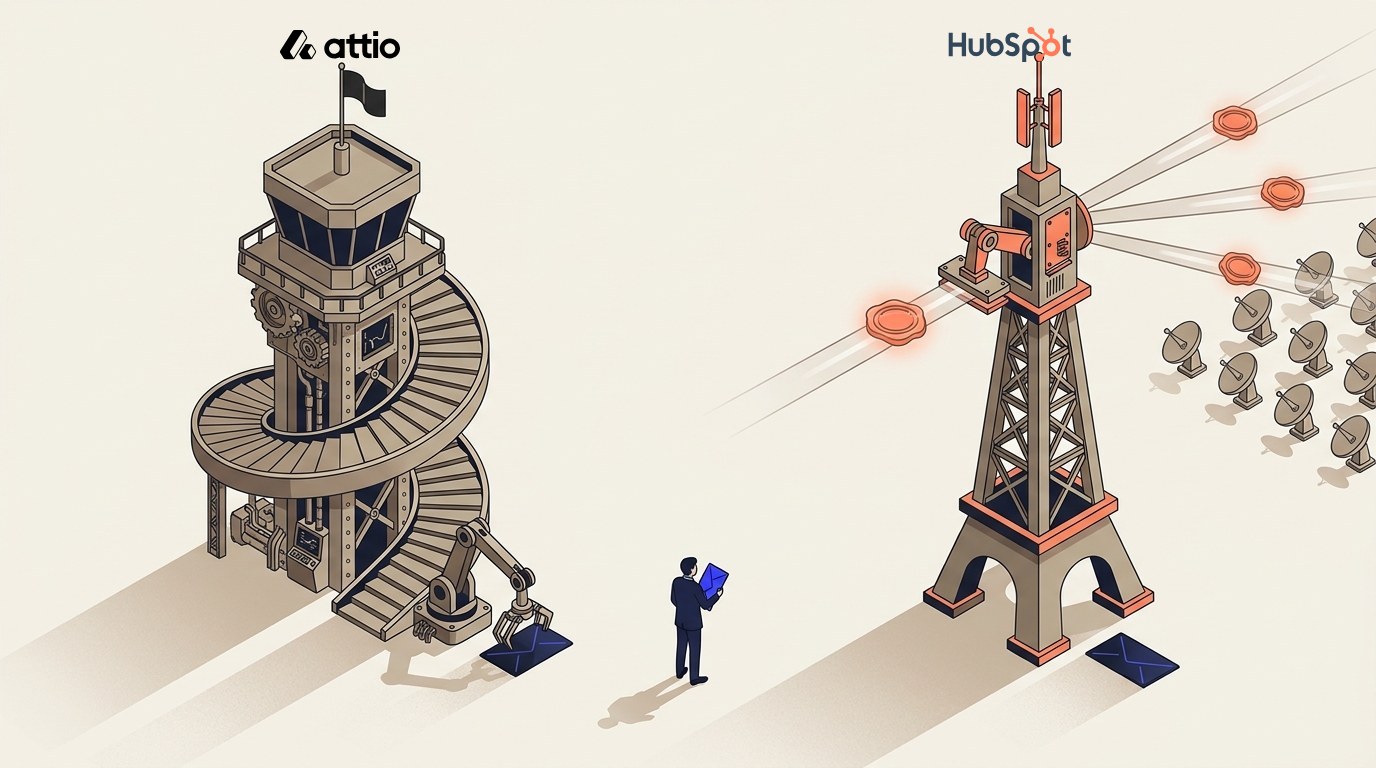
Attio's rate limit is the same for every customer regardless of plan: 100 reads and 25 writes per second, plus a separate score-based limit on its List records and List entries endpoints that sums complexity across a 10-second sliding window. HubSpot ties its limit to the subscription tier, which means a Free or Starter HubSpot integration hits its ceiling sooner than a Professional or Enterprise one, and HubSpot sells a paid add-on (an extra 1,000,000 calls a day for €490 a month, per its own price calculator) to raise it further. Neither structure is objectively better; a small team on Attio's flat limit gets more headroom than a small team on HubSpot's entry-tier limit, while a large HubSpot Enterprise account can buy its way past both.
Which one connects to more of the stack?
Integrations
Checked 29 September 2026Total listed integrations
Edge: HubSpot
Not published as a single count"Over 2,000 leading apps and web services"Zapier
Edge: Even
Confirmed, with published zap templatesConfirmedMake
Edge: Even
ConfirmedConfirmedn8n
Edge: HubSpot
No official Attio node published; only community packages exist on npmOfficial trigger and action nodes publishedLinkedIn Sales Navigator
Edge: HubSpot
No official app found in Attio’s app directoryNative integration, from ProfessionalMCP server (AI assistant access)
Edge: Even
Published, connects Attio to Claude, ChatGPT and other MCP clientsPublished, a remote MCP server for HubSpotRead from: Attio Apps directory · Make: Attio app documentation · Zapier: Attio integrations · n8n: Attio integration search · HubSpot: Connect HubSpot and LinkedIn Sales Navigator · HubSpot: Integrate with the remote MCP server.
This is the clearest gap in the comparison. HubSpot names its integration count on its own pricing page ("over 2,000") and ships a native LinkedIn Sales Navigator connection from Professional up. Attio doesn't publish a total integration count anywhere in its app directory, and searching n8n's own integrations page for an official Attio node returns nothing, only third-party community packages built by individual developers on npm. A team that lives in n8n or prospects daily through Sales Navigator has a materially easier time wiring HubSpot into that stack than Attio.
What do the two include on AI, security and support?
AI, security and support
Checked 29 September 2026AI features
Edge: Even
Ask Attio, Workflows AI generation, Custom Agents, a Web Agent for research, all metered by seat and workspace creditsBreeze AI agents and assistants inside workflows, metered by creditsSSO
Edge: HubSpot
Enterprise onlyProfessional and EnterpriseSCIM
Edge: Attio
Enterprise onlyNot detailed in the sources reviewed for this pieceAccess permission granularity
Edge: Attio
None (Free), Basic (Plus), Advanced with per-team and per-individual control (Pro, Enterprise)Custom permission sets: Enterprise onlyPayment by invoice
Edge: Even
Enterprise onlyNot detailed in the sources reviewed for this pieceSecurity certification
Edge: Depends on your setup
States ISO 27001 certification in a 2022 changelog entry; current SOC 2 status could not be confirmed, its trust portal returned no content on the date checkedSOC 2 Type II (report under NDA). States it is not ISO 27001 certifiedSupport
Edge: Even
Help center on every plan, chat and email from Plus, priority support on Pro and Enterprise, a migration service on EnterpriseChat and email from Starter, phone from Professional, a paid 1-hour-response Premium Support add-on on EnterpriseRead from: Attio pricing (EUR) · HubSpot Trust Center.
Security certification is the one row worth a caveat beyond the table. Attio's own changelog recorded an ISO 27001 certification in 2022, which is old enough that it's worth confirming directly with Attio before relying on it in a vendor security review, and its trust portal did not return readable content when checked for this piece. HubSpot's position is the mirror image and stated plainly on its own Trust Center: it holds SOC 2 Type II (report available under NDA) and states outright that it is not ISO 27001 certified. Neither company comes out ahead on certification. They hold different ones, and both gaps are the vendor's own disclosure, not a guess.
Where each one is weaker
Every product loses somewhere. These are the limits each vendor's own documents show, stated with the same weight as the strengths above.
Attio's weak points
- No published founding year or total integration count, and its "190+ team members" figure is the only headcount signal available, which makes it harder to judge company maturity against HubSpot's stated 2006 founding and 9,000+ employees.
- Custom objects, advanced permissions and sequences all sit behind Pro or Enterprise; the Free and Plus tiers are close to HubSpot's own entry tiers in what they leave out.
- Sequences explicitly aren't built for cold or high-volume outreach, and Attio isn't an email service provider, so every send rides on the limits of your own connected Gmail or Microsoft account.
- No official n8n integration and no LinkedIn Sales Navigator app in its own directory, unlike HubSpot on both counts.
- SSO and SCIM are Enterprise only, with no published SSO option below that tier.
- Its current SOC 2 status couldn't be confirmed from its own trust portal on the date checked, and its ISO 27001 claim traces to a 2022 changelog entry.
- Its iOS and Android apps carry far fewer ratings and installs than HubSpot's, which is a scale signal more than a quality one, but it's the only public signal available.
HubSpot's weak points
- Costs more at every tier once seats scale, and Professional and Enterprise carry a required onboarding fee of €1,470 or €3,420 that Attio has no equivalent for.
- Custom objects are Enterprise only. Attio reaches the same capability at its mid tier.
- Its own developer documentation, as reviewed for this piece, didn't publish a webhook retry policy or delivery timeout, where Attio states both precisely.
- Its API limit is tiered by subscription plan, so cheaper tiers hit a lower ceiling sooner, and raising it further costs an extra €490 a month per capacity pack.
- States plainly it is not ISO 27001 certified, which rules it out for any buyer whose procurement requires that specific certification.
- Most AI features run on credits that reset monthly with no rollover, and the discounted Starter price has no published end date, so it's not a number to plan a multi-year budget around.
Attio or HubSpot: which should you choose?
Choose by what your team actually needs to model and run, not by which one has more features listed.
| If your team... | Lean towards | Because |
|---|---|---|
| Needs a data model that doesn't look like contacts, companies and deals | Attio Pro | Custom objects from the mid tier, up to 12 combined, versus HubSpot's Enterprise-only custom objects |
| Runs marketing, service or a website on the same customer records | HubSpot | Attio has no equivalent to HubSpot's other hubs sharing one database |
| Wants webhook delivery it can trust and debug without guessing | Attio | Published retry count, timeout and a named degraded state; HubSpot's retry policy isn't published |
| Needs email sequences that run as part of the CRM, not through a personal inbox's own limits | HubSpot Professional | Published per-user daily sending caps; Attio's sequences explicitly aren't built for cold or high-volume outreach |
| Prospects in LinkedIn Sales Navigator every day | HubSpot Professional | Native integration; Attio's app directory has none |
| Has engineers who live in n8n | HubSpot | Official n8n nodes exist for HubSpot; Attio has community packages only |
| Needs SSO or SCIM without an enterprise contract | HubSpot | SSO from Professional; Attio holds both behind Enterprise |
| Wants a flat, predictable API limit regardless of plan | Attio | One rate limit for every tier; HubSpot's ceiling depends on what you pay |
| Needs to name a specific security certification during procurement | Depends which one | Attio claims ISO 27001 (dated 2022); HubSpot holds SOC 2 Type II and states it does not hold ISO 27001 |
If the table points both ways, the real question is usually whether your process is settled enough to be worth building into a flexible, configurable system, or whether you'd rather adopt a larger platform's defaults and move faster on day one. That's a scoping question, not a features one. For a similar comparison between two more pipeline-first CRMs, see HubSpot vs Pipedrive, and for what a CRM migration actually involves once you've picked one, see who holds your data during a CRM migration.
Sources
Attio, Pricing page (EUR), read 29 September 2026. Plan prices, seat and workspace credits, per-tier limits (2026)
Attio, About Attio. Team size, locations (2026)
Attio, Seed round announcement, November 2021 (2021)
All 31 sources and how they were checked
Attio, Series A round announcement, 1 March 2023 (2023)
Attio, $33 million funding announcement, 28 August 2024 (2024)
Attio, $52 million Series B announcement, led by GV. "We've now raised $116 million to date" (2025)
Attio, Understanding objects, Attio's data model (2026)
Attio, Introduction to workflows (2026)
Attio, Create a sequence. Use cases, and cases where sequences "should not be used" (2026)
Attio, Handling rate limits. 100 read/25 write requests per second, score-based limits (2026)
Attio, Configuring webhooks. HMAC-SHA256 signing, idempotency, retry policy, delivery timeout (2026)
Attio, Apps directory (2026)
Apple App Store, Attio CRM app listing, ratings read 29 September 2026 (2026)
Google Play, Attio app listing, ratings and installs read 29 September 2026 (2026)
HubSpot, Sales Hub pricing and plan table (EUR), read 29 September 2026 (2026)
HubSpot, Create a Bundle price calculator, read 29 September 2026 (2026)
HubSpot, Product & Services Catalog. Custom objects, permissions, teams (2026)
HubSpot, Create workflows, last updated 25 September 2026 (2026)
HubSpot, Use webhooks with HubSpot workflows, last updated 16 September 2026 (2026)
HubSpot, Validating requests (webhook signatures v1 to v3) (2026)
HubSpot, API usage guidelines and limits, last modified 31 August 2026 (2026)
HubSpot, APIs by tier (2026)
HubSpot, Connect HubSpot and LinkedIn Sales Navigator, last updated 31 August 2026 (2026)
HubSpot, Integrate with the remote HubSpot MCP server (2026)
HubSpot, Trust Center: SOC 2 Type II, ISO 27001 answer (2026)
HubSpot, Our story. Founding year, employees, customers (2026)
Apple App Store, HubSpot app listing, ratings read 29 September 2026 (2026)
Google Play, HubSpot app listing, ratings and installs read 29 September 2026 (2026)
Make, Attio app documentation (2026)
Zapier, Attio integrations and zap templates (2026)
n8n, Attio integration search (no official node found, 29 September 2026) (2026)
Every figure on this page was read from the vendor's own page on 29 September 2026 and is linked above. Prices change often; if a number here disagrees with the vendor's page on the day you read it, the vendor's page is right. Salestruct has no commercial relationship with Attio or HubSpot.
Common questions
If you want a second pair of eyes on your own setup, Salestruct runs a free diagnostic.
Read next.
All articlesHubSpot vs Pipedrive: which CRM for a sales team?
Every plan, limit and price, read from each vendor's own pages on 29 September 2026: interface, automation, webhooks, API, integrations, AI, security, support and year-one cost at 5 and 15 seats.
CRM migration: who holds your data while it moves?
I read the termination clause in ten CRM contracts, asking one question: when you leave, how long do you have to get your data out? Five of the ten promise you nothing.