Sales infrastructure: the rules layer nobody builds.
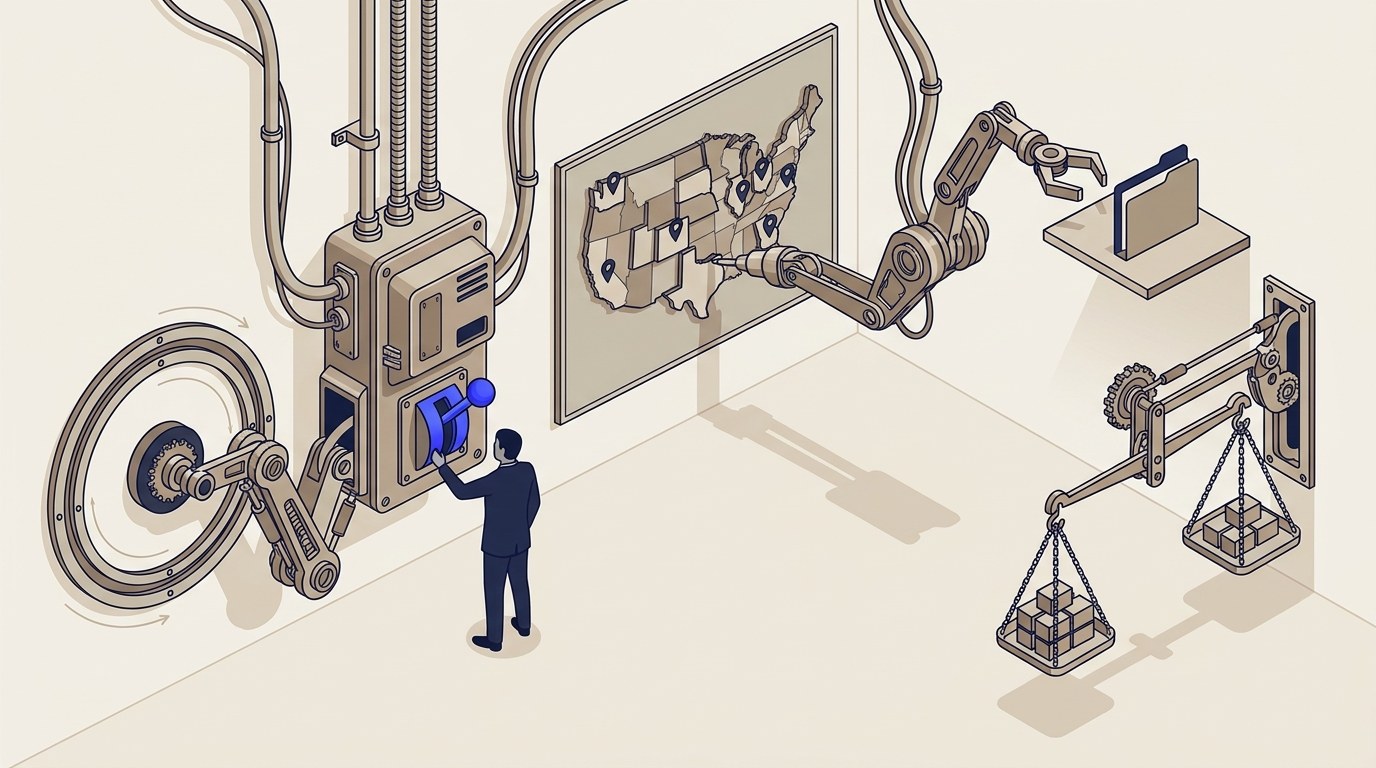
Companies without a dedicated ops person usually own the tools and improvise everything between them. The list is bought, the CRM is bought, the sending tool is bought, and the rules that connect the three live in someone's head, which is the part that breaks when that person is on holiday.
 Toni MedicSalestructSeptember 9, 20268 min readSales Operations
"Sales infrastructure" gets used to mean whatever the person saying it sells. Tooling, if they sell tools. Process, if they sell consulting. Headcount, if they are a recruiter.
Here's the version that survives contact with a real company: it's the set of things that have to exist before a salesperson can do their job the same way twice.
The short version
- Five layers: where names come from, how you reach them, what the system records, the rules connecting those three, and who holds the accounts.
- Most teams without a dedicated ops person have bought layers one, two and three, and never built layer four.
- Layer four is the only one that cannot be purchased, which is exactly why it gets skipped.
- When a sales operation "depends on one person", that person is almost always holding layer four in their head.
- A tool problem produces a consistent failure. A rules problem produces an inconsistent one, which is how you tell them apart.
What is sales infrastructure?
Sales infrastructure is everything a sales team needs in place before selling becomes repeatable: the source of prospects, the channels used to reach them, the record of what happened, the rules governing all three, and the accounts everything sits in.
It is not the same as a tech stack. A tech stack is a list of purchases. Infrastructure is what those purchases do when they are connected, plus the parts that were never for sale.
The five layers
1. Sources. Where names come from. Bought lists, enrichment tools, inbound forms, referrals, events, the founder's network. Most companies have several and can't say which produces the meetings that close.
2. Outreach. How you reach those names. Email sending, LinkedIn, phone, the sequencing that decides the order and the gaps. This layer is usually the best resourced, because it has the most vendors selling into it.
3. The record. What the system knows: the CRM, the fields on it, what a stage means, what counts as a next step. This is the layer everyone points at when something breaks, and it is usually a symptom rather than a cause.
4. The rules. Who picks up a new lead and within how long. What has to be true before a deal moves. Who is allowed to change a field. What happens when someone replies while the owner is away. What the handover contains when a deal is passed on.
5. The accounts. Whose name the domains, the sending mailboxes, the ad accounts, the CRM subscription and the data are in. Boring until the day it isn't, and the day it isn't is always a day you did not schedule.
Layer four is the one that is missing

Layers one, two, three and five all have vendors. You can buy your way to a list, a sending tool, a CRM and a set of accounts in an afternoon, and most teams have.
Layer four has no vendor, because it is decisions. That makes it the layer most likely to exist only as convention: things the team happens to do, learned by watching each other, never written down and never enforced by the software.
That produces a specific symptom. The operation works, and it works differently depending on who is doing it. Two reps handle the same inbound lead in two different ways and both think they are following the process, because there is no process, there is a habit with two versions.
The diagnostic that separates a tool problem from a rules problem: a tool problem fails the same way every time. A rules problem fails differently every time. If your answer to "what happens when X" is "depends who catches it", that is layer four, and no purchase fixes it.
Which layer is failing you
Read the symptom, not the complaint. The complaint is almost always "the CRM is bad".
| What you observe | The layer |
|---|---|
| Plenty of activity, few qualified conversations | 1, sources |
| Good conversations, nothing lands in the calendar | 2, outreach |
| Nobody can answer a question about a live deal | 3, the record |
| Two people handle the same situation differently | 4, rules |
| It only works when one specific person is available | 4, rules |
| Nobody can say who holds the sending domains | 5, accounts |
The two rows in the middle of that table are the ones most often misread as a CRM problem and treated with a CRM purchase, which is how a company ends up on its third system in four years with the same complaint.
Building layer four without a project
It is smaller than it sounds. Four decisions, each written in a sentence, each enforced by a setting rather than by a reminder.
Who picks up a new lead, and by when. One name or one rule, and a number of hours. Not "the team". If the answer depends on who happens to be looking at the inbox, you do not have this decision, you have an inbox.
What has to be true before a deal advances. One binary test per stage, produced by the buyer, stored in a field that can be required. This is the enforcement layer for pipeline stages and the highest-value item here.
Who may change the shape of the system. Fields, pipelines, automations. One named person, permission removed from everyone else. The detail is in who is allowed to change what.
What a handover contains. Write the list once: the next step and its date, who the buyer's decision-maker is, what they have already been sent, the constraint they named. Then require those fields. A handover that depends on a conversation fails on exactly the days that conversation cannot happen.
Nothing there needs new software. All four are settings in what you already run, which is the point: the missing layer is missing because it was never a purchase, not because it was expensive.
If you want a single question to start with, ask two people what happens to a lead that arrives on a Saturday. Different answers, and you have found layer four.
Common questions
Sources
This post carries no external vendor claims, so there is nothing to cite here beyond the linked posts, each of which records its own primary sources. The five layers and the four decisions are a reasoned model rather than research, and are presented as such.
Read next.
All articlesSales process steps: a clear exit test for each one
Gartner counts six buying jobs. Salesforce names seven steps. HubSpot names seven different ones. Pipedrive names nine. LinkedIn's own page names five in one place and eight in another. The step count isn't the problem. None of the vendor steps end on something the buyer produced.
What is lead routing? Models, rules and where it breaks
Routing is the set of rules that decides who owns a new lead and how fast. Four models, one catch-all rule every setup needs, and the three places a lead goes quiet.