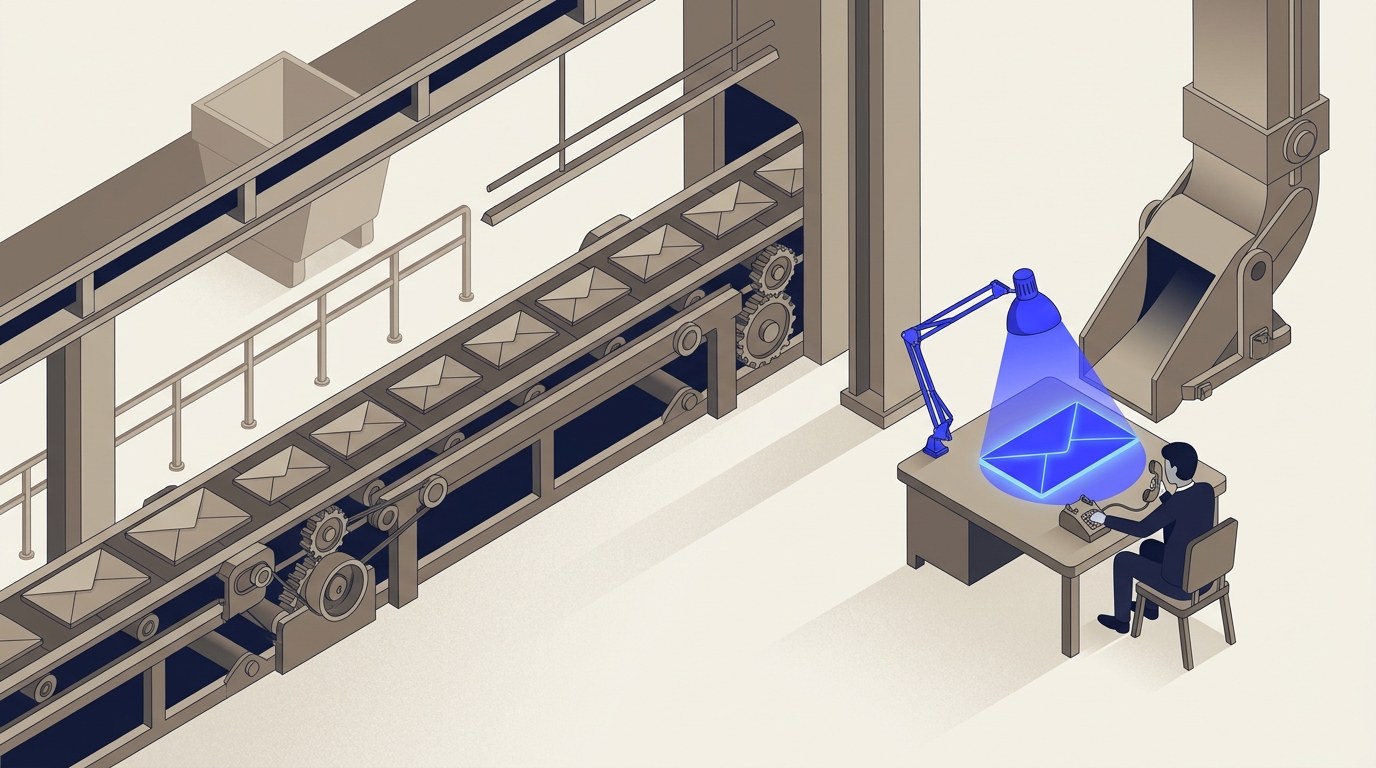
Lead generation agency or a sales system build? If your sales process already converts, hire the agency.
More leads only help if the team can turn them into deals. How to tell which problem you have, when a lead generation agency is the right call, and when the money is better spent behind the leads first.
 Toni MedicSalestructOctober 8, 20269 min readSales Operations



A lead generation agency is the right hire when your sales process already turns leads into deals and the only thing missing is more of them. If leads already go cold, sit unanswered or vanish somewhere between the first reply and the proposal, more leads will mostly mean more of that. In that case the order that holds up is fix the sales system first, then pay for lead generation.
The short version
- Hire a lead generation agency when the leads you get today are answered fast, followed up properly, tracked in a CRM you trust, and closed at a rate you're happy with. Your constraint is volume.
- Fix the sales system first when you can't say what happens to a lead after it arrives, when follow-up depends on who remembers, or when nobody trusts the pipeline numbers.
- A good lead generation agency is better than a build team at the thing it does: finding people, running campaigns and filling calendars. A build team won't beat it at volume.
- A build is better at what happens next: routing, follow-up, the CRM, reporting and the process reps run. A lead generation agency usually stops at the handoff.
- Salestruct does both, and in that order: sales system first, lead generation second. If yours already converts, we'll say so and you can go straight to lead generation, with us or anyone else.
Lead generation agency or sales system: the short answer
Ask one question before you sign with anyone: if we doubled the leads next month, would we close roughly double the deals?
If the honest answer is yes, you have a volume problem and a lead generation agency is built to solve it. If the answer is "we'd probably drop half of them", you have a conversion problem, and paying for more leads makes it more expensive without fixing it.
If you don't know the answer, that's normal. It's hard to see from inside the business, and the rest of this page is about finding out.
How the two options compare
| Lead generation agency | Sales system build first | |
|---|---|---|
| What it fixes | Not enough leads or meetings | Leads that arrive and don't turn into deals |
| What you see first | Meetings on the calendar | Faster replies, cleaner pipeline, follow-up that happens; more meetings come later |
| Where it stops | Usually at the handoff: booked meeting or a lead in your inbox | Usually before lead generation, unless you add it |
| Skill depth | Campaigns, lists, copy, channels, sending infrastructure | CRM, routing, follow-up, reporting, process, AI that drafts for reps |
| Works best when | Your process already converts | Your process leaks or nobody can see where it leaks |
| Fails when | Leads land in a process that can't handle them | You genuinely just need more volume, and wait months to get it |
| Cost shape | Usually monthly, for as long as you want leads | Usually a one-off project fee for the build |
| What you're left with if you stop | Whatever the agency built in your name, if anything | A system that keeps running, if it was built in your name |
Two rows matter more than the rest.
Where it stops. A lead generation agency is judged on leads or meetings, so that's what it optimises for. What happens after the meeting is booked usually isn't its job, and it shouldn't be blamed for that. The trouble starts when nobody owns that part at all, and the agency's results get judged on numbers that depend on your follow-up.
Fails when. Both options fail, in opposite situations. Lead generation into a leaky process produces activity and not much revenue, and the agency gets blamed. A system build when you really just need volume produces a tidy CRM and an empty calendar for longer than you can afford.
When a lead generation agency is the right call
Go straight to a lead generation agency when most of these are true:
- New leads get answered quickly, by a named person, with a rule for who picks them up.
- Every lead and deal lives in the CRM, and the pipeline report matches what your sales leader would say out loud.
- Follow-up happens by process, not by memory. A lead that doesn't reply on Monday gets another touch, and you could show someone the rule.
- You know your rough close rate from first meeting to signed deal, and you're happy with it.
- Reps have room in their week for more conversations.
If that's you, a build team is the wrong spend. You'd be paying to rebuild something that works. A good lead generation agency, or a specialist in the one channel your buyers actually use, will move your numbers faster.
When to fix the sales system first
Fix the system before you buy more leads when you recognise most of these:
- Nobody can say how long a new lead waits for a first reply, or the honest answer is "it depends who's in".
- Leads from different sources land in different places: a form inbox, a spreadsheet, someone's personal email, the CRM.
- The pipeline report gets checked against reps' own notes before anyone believes it.
- Follow-up stops after one or two tries because there's no sequence, only good intentions.
- You've paid for leads before and couldn't tell afterwards whether the campaign or the follow-up was the problem.
The last one is the most expensive. If you can't see what happened to the leads you already paid for, you can't judge the next agency either. Fixing the system first also gives you the numbers to judge whoever does the lead generation after.
Doing both, in the right order
If you sell something expensive, you may well end up needing both. Then the question is sequence.
Build first, and the leads that arrive later land in a process that answers them, routes them, follows up and reports honestly on what happened. That's when a lead generation agency's work is easiest to judge, because its leads and your follow-up are measured separately.
Run lead generation first into a weak process, and two things happen at once: you pay for leads you can't convert, and you can't tell whose fault that is. The agency says the leads were good, the reps say they weren't, and nobody has the data to settle it.
There's one exception worth naming. If the pipeline is so empty that the business is at risk, buy leads now, fix the obvious leaks in parallel (who answers, how fast, where it's logged), and do the deeper build once there's revenue to protect.
Who a sales system build is not for
A build-first approach is the wrong call if:
- Your process already converts and you can show it. Go get more leads.
- You need meetings this month to keep the business alive. Lead generation first, fix the basics alongside.
- You sell something low-priced and quick to buy. The cost of building a full sales system rarely pays back on small deals.
- You want someone to take a brief and start immediately. We don't start until both sides agree on what's actually broken, and that takes a conversation first.
Where Salestruct fits
We're a slightly awkward entry in this comparison, because we sell both sides of it.
Salestruct builds AI sales systems for companies selling something expensive through real salespeople: the CRM, routing and follow-up, reporting, and AI that researches and drafts so reps spend more time selling, with a person approving anything that reaches a prospect. After the build, we can also run lead generation for you: cold outbound, paid ads, search and content, synced with your sales team and CRM.
The rule we hold ourselves to is the one on this page: sales system first, lead generation second. We won't run lead generation into a process that can't convert it, because that's paying for leads nobody will follow up properly. If your process already works, we'll tell you on the diagnostic, and you can go straight to lead generation with us or with someone else.
The build is a scoped project fee, quoted from a free diagnostic. Standby and Operated are monthly, each quoted from the diagnostic, and nothing ongoing is compulsory. Everything is created in your name from day one.
We're the better choice when the leak is behind the leads. A specialist lead generation agency is often the better choice when the process is fine and you need volume in one channel fast.
Common questions
Common questions
Sources
This page makes no statistical claims. Every recommendation above is a judgement about sequencing, stated as one, so there is nothing to cite. Checked 5 October 2026.
If you want to know whether your problem is leads or what happens after them, Salestruct runs a free diagnostic.
Read next.
All articlesWhat is speed to lead? Definition, benchmarks and fixes
Speed to lead is the time between a prospect filling in your form and the first time someone on your team tries to reach them. Here's what the research says a good response time looks like, what most companies manage, and how to shorten yours.
Inbound lead qualification: which leads to call first
Not every form fill is a demo request. A method for tiering inbound leads by intent, fit and timing, using only the fields that exist the moment someone submits.