What is revenue operations?
RevOps is what happens when marketing, sales and customer success stop reporting from three different spreadsheets. What it owns, how it differs from sales ops, and the signs a company needs one before it has the headcount to hire one.
 Toni MedicSalestructSeptember 30, 202611 min readCRM & Pipeline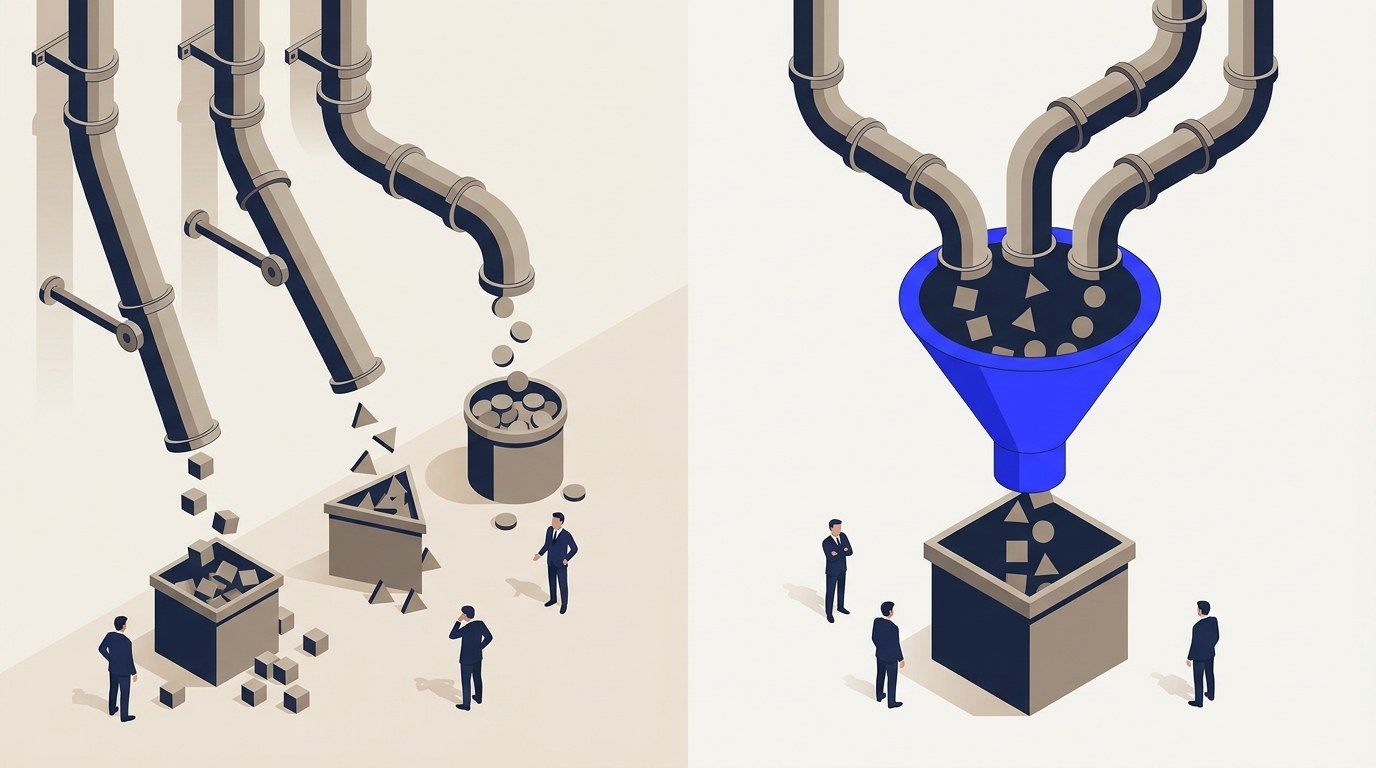
Marketing has a number for how many leads it sent. Sales has a different number for how many it actually worked. Customer success has a third number for how many of those customers are still around a year later. Nobody in the room agrees which number is right, because none of the three systems that produced them talk to each other.
Revenue operations is the function built to stop that argument before the meeting starts.
The short version
- Revenue operations (RevOps) is the function that aligns marketing, sales and customer success around one set of data, one set of process, and one set of KPI definitions. HubSpot defines it as "the business function that aligns sales, marketing, and customer success around shared data, processes, and goals to drive predictable, scalable revenue growth."
- Sales operations is narrower by design: pipeline management, quota setting, CRM hygiene and rep enablement, reporting to the sales org alone. RevOps sits above sales ops, marketing ops and customer success ops and owns the handoffs between them.
- Adoption moved fast: LeanData's 2019 survey of 2,462 B2B professionals found the share of companies with a dedicated RevOps group rose from 20% to 31% in a single year. Forrester's 2021 study of 927 global decision-makers found nearly 60% of firms without RevOps planned to stand one up within 12 months.
- Deloitte's 2024 survey of 650 US B2B sales executives found organizations with a RevOps function were 1.4 times as likely to exceed their 2023 revenue goal by 10% or more, while 40% of all respondents said less than half their sales team hit quota that year.
- Most companies do not need a full RevOps team on day one. What they need is one clear owner, a defined scope, and a CRM that is treated as the system of record rather than a filing cabinet nobody trusts.
How this page was researched
This page draws on three primary studies fetched and read directly on 29 September 2026: LeanData's "The State of Revenue Operations 2019" (a survey of 2,462 B2B sales and marketing professionals), Forrester Consulting's "Rise Of The Revenue Operations" study commissioned by Salesforce (927 global respondents, published July 2021), and Deloitte Digital's "Is RevOps the new driver for B2B growth?" (650 US B2B sales executives across 13 industries, published September 2024). It also cites HubSpot's own RevOps guide, read the same day, for its four-pillar framework and ownership models. Salestruct is not affiliated with LeanData, Forrester, Salesforce, Deloitte or HubSpot, and none of them reviewed this page.
What is revenue operations?
Revenue operations is the function that unifies the systems, data and processes behind marketing, sales and customer success into one operating model, so the three teams work from the same numbers and the same handoffs instead of three separate ones.
HubSpot's own definition: RevOps "is the business function that aligns sales, marketing, and customer success around shared data, processes, and goals to drive predictable, scalable revenue growth." LeanData, in its 2019 industry survey, described it as bringing "the operations teams supporting sales, marketing and customer success together under one umbrella." Forrester's 2021 report, commissioned by Salesforce, defines it as "the strategic and organizational alignment of the resources, people, processes, and technologies that drive the conversion of prospects to customers and maximize customer lifetime value."
Strip the vendor language and three things repeat across all three definitions:
- One data layer. A single agreed definition of "pipeline," "qualified lead" and "churn," instead of three teams each computing their own.
- One process layer. Handoffs between marketing, sales and customer success have a named owner, a trigger and a set of information that has to travel with the deal.
- One reporting layer. Leadership works from one dashboard instead of reconciling three exports before a meeting can start.
Revenue operations vs sales operations
The two get used interchangeably and they are not the same scope. Per HubSpot's own comparison: "Sales operations focus on optimizing the sales team's performance. Its scope is narrow by design: pipeline management, quota setting, CRM hygiene, sales forecasting, and rep enablement. Sales ops reports to the sales org, and its goals are measured by sales outcomes such as win rate, ramp time, and cycle length."
Marketing operations is the same idea scoped to marketing: campaign execution, lead scoring, attribution, marketing automation, measured on MQL volume, cost per lead and campaign ROI.
Revenue operations is what exists when sales ops, marketing ops and customer success ops report into one function instead of three. It owns the full customer lifecycle, "from first marketing touch to closed deal to renewal and expansion," rather than one team's slice of it. HubSpot's own signal for when to make the move: "if your sales and marketing teams are already aligned but you're still seeing inconsistent data, broken post-sale handoffs, or unpredictable revenue, you're getting the signal to move from sales ops to RevOps."
What does a RevOps function actually own?
HubSpot's guide organizes the scope into four pillars, and each one maps to a real failure mode when it is missing.
1. Operations. The standardized workflows that govern how a lead moves through the funnel, a deal progresses, and an account gets managed, each with a defined owner and a documented entry and exit point. HubSpot's own advice here is worth repeating in full: "Start here before touching your tech stack. Automating a broken process just makes it break faster."
2. Enablement. Training and content for every customer-facing team, not just new sales reps, built from what the top-performing reps, marketers and CSMs are actually doing differently.
3. Insights. KPI definitions, reporting standards and forecasting, and the difference between reporting what happened and explaining why. HubSpot's pro tip: align every team on a single definition for every metric, because "pipeline," "qualified lead" and "churn" mean different things at most companies that have not done this work.
4. Tools and technology. The CRM, marketing automation, and analytics platforms, and specifically whether they communicate cleanly with each other. HubSpot frames the job as rationalizing the stack rather than adding to it, prioritizing integration depth over feature count.
When does a company actually need RevOps?
Not on day one, and not at a fixed headcount. The signal is a specific kind of pain, not a specific team size.
Sign one: the teams cannot agree on the same number. LeanData's 2019 survey found data was the single least-aligned part of the revenue engine, scoring 5.71 out of 10 on an internal alignment scale where 10 was "fully integrated and aligned," the lowest of six areas measured.
Sign two: you are already missing quota and cannot say why. Deloitte's 2024 survey found 40% of the 650 B2B sales executives it surveyed said less than half their sales team hit quota in 2023. The same study found organizations with an established RevOps function were 1.4 times as likely to exceed their 2023 revenue goal by 10% or more.
Sign three: growth has stopped being predictable, even though activity has not slowed. This is the gap Forrester's 927-respondent study measured directly: companies without a RevOps function reported an expected pre-to-post revenue growth move from 5% to 8%; companies that already had one reported a realized move from 5% to 7% (each measured against its own baseline, on separate respondent bases of 169 and 742). Growth without alignment is a forecast built on hope.

None of these signs require a dedicated RevOps hire to start closing. HubSpot's own guidance for smaller teams: start with "one senior RevOps hire who can own the revenue operations strategy and execution, then scale the team as process complexity and headcount grow." Most companies never need a fully staffed function. They need one clear owner and a defined scope.
Who owns revenue operations?
There is no universal answer, and the studies here show the pattern rather than a rule. LeanData's 2019 survey asked companies with a centralized RevOps group who it reported to, and found three executives absorbed most of it: Chief Revenue Officer or Head of Revenue Operations (26%), CEO or President (20%), and Chief Operating Officer (17%). The same survey found the CRO was roughly 4 times more likely to own RevOps than a CMO, and close to twice as likely as a Chief Sales Officer.
HubSpot's own framework describes two structures rather than one: centralized RevOps, where a dedicated function sits outside sales, marketing and customer success and serves all three, owning data governance, tech stack management and reporting standards; and partially centralized RevOps, where some functions (CRM administration, forecasting) are consolidated under one RevOps lead while marketing ops and customer success ops keep some independence. HubSpot describes the partial model as "where most companies start."
A worked example, with invented numbers
The arithmetic below uses made-up figures to show the mechanism, not a client result.
- Before RevOps: three exports, three numbers
Marketing reports 400 leads sent this month. Sales reports 220 "worked," because its CRM only counts a lead once a rep opens it. Customer success reports 85 renewals due, tracked in a separate spreadsheet nobody else can see. Nobody in the Monday meeting can say what the real funnel looked like last month, because three systems produced three numbers with three different starting points.
- Define the shared metric first
Before touching any tool, the three teams agree on one definition: a "lead" becomes a "qualified lead" the moment it meets three named criteria, timestamped the moment that happens, in one field every team can see. This is the step HubSpot's guide puts first, before any tech consolidation: "map what already exists" so "the goal is to surface the gaps ... that are quietly costing revenue," before anything gets fixed.
- Standardize the handoff
MQL to SQL, SQL to opportunity, closed-won to onboarding: each transition gets a documented trigger, a named owner on both sides, and the minimum context that has to travel with it (account history, prior objections, contract terms). A handoff without a named receiver is where deals go quiet.
- One dashboard, not three
Pipeline created, stage conversion, renewal risk and quota attainment now live on one dashboard, built from the same underlying fields the handoffs above require. The Monday meeting stops being three teams defending three numbers and starts being one team looking at one number.
- Measure it against the baseline
Three months later, the company compares stage conversion and time-to-renewal against the pre-RevOps baseline from step 1. This is the same before/after structure Forrester's and Deloitte's surveys used at a market level, just run on one company's own numbers instead of a survey panel.
Common mistakes
- Buying a tool before fixing the definition. HubSpot's own pro tip applies directly: "automating a broken process just makes it break faster." A dashboard connected to three disagreeing systems just makes the disagreement load faster.
- Treating RevOps as a sales-only initiative. Sales infrastructure that ignores marketing and customer success recreates the same silo with a new name on the org chart.
- Backfilling the fields that matter. A source or stage-change field filled in at month end by whoever remembers is not data, and every RevOps KPI computed from it inherits that guess.
- Naming a RevOps lead with no authority over the CRM. If the person cannot change a required field or a stage definition, they own a title, not a function.
- Confusing sales ops for RevOps. Optimizing quota-setting and CRM hygiene inside the sales org alone is sales ops. It stays sales ops until customer success and marketing report into the same process.
Frequently confused terms
| Term | What it is | How it differs from RevOps |
|---|---|---|
| Sales operations | Pipeline management, quota setting, CRM hygiene and rep enablement, scoped to the sales org and measured on sales outcomes | Narrower by design. RevOps sits above it and adds marketing and customer success into the same operating model |
| Marketing operations | Campaign execution, lead scoring and attribution, scoped to marketing and measured on MQL volume and cost per lead | Same relationship as sales ops: one department's operations function, not the cross-functional layer |
| Sales pipeline | The set of active deals moving through defined stages toward close | RevOps owns the process and reporting around the pipeline, not the pipeline itself. See what is a sales pipeline |
| RO&I (revenue operations and intelligence) | A category of software tools (forecasting, conversation intelligence, pipeline analytics) that support a RevOps function | A tool category, not the function. Buying RO&I software does not create alignment on its own |
| CRO (Chief Revenue Officer) | An executive role accountable for the full revenue engine across sales, marketing and customer success | LeanData's 2019 survey found RevOps most commonly reports to the CRO, but the CRO is a role, not the function itself |
If your CRM cannot produce clean answers to the questions a RevOps function needs to ask it, that is usually the first thing worth fixing, before you hire for a role that cannot succeed on top of the data you have today.
Sources
LeanData, The State of Revenue Operations 2019: A Survey of 2,462 B2B Sales and Marketing Professionals. Fetched and read 29 September 2026 (2019)
Forrester Consulting (commissioned by Salesforce), Rise Of The Revenue Operations: The Revenue Operations Maturity Index. A survey of 927 global respondents, published July 2021. Fetched and read 29 September 2026 (2021)
Deloitte Digital, Is RevOps the new driver for B2B growth? A study of 650 US B2B sales executives across 13 industries, conducted summer 2024, published September 2024. Fetched and read 29 September 2026 (2024)
All 4 sources and how they were checked
HubSpot, What is Revenue Operations (RevOps)? Page states last updated 07/14/26. Fetched and read 29 September 2026 (2026)
Every figure above is quoted or computed directly from the source named, opened on the date shown. A separate Forrester and Clari statistic on win-rate and retention gains, referenced secondhand on the HubSpot page, is not repeated here because the original Forrester/Clari study was not independently located and opened. Where a source's own chart numbers were ambiguous in scanned form, such as Deloitte's per-capability "extremely effective" breakdown, this page describes the finding qualitatively rather than pairing specific percentages to specific categories.
Common questions
If you want a second pair of eyes on your own setup, Salestruct runs a free diagnostic.
Read next.
All articlesSales infrastructure: the rules layer nobody builds
Companies without a dedicated ops person usually own the tools and improvise everything between them. The list is bought, the CRM is bought, the sending tool is bought, and the rules that connect the three live in someone's head, which is the part that breaks when that person is on holiday.

Revenue operations KPIs your CRM cannot calculate
Most RevOps KPI lists mix three different kinds of number: ones the CRM computes for you, ones it can compute once you add a field, and ones it will never hold the data for. Nobody labels which is which, so teams build dashboards on numbers the system was never able to produce.