GoHighLevel vs HubSpot: which fits your sales team?
Every plan, limit and price, read from each vendor's own pages on 29 September 2026: pricing model, automation, webhooks, API, integrations, AI, security and support.
 Toni MedicSalestructSeptember 30, 202619 min readCRM & Pipeline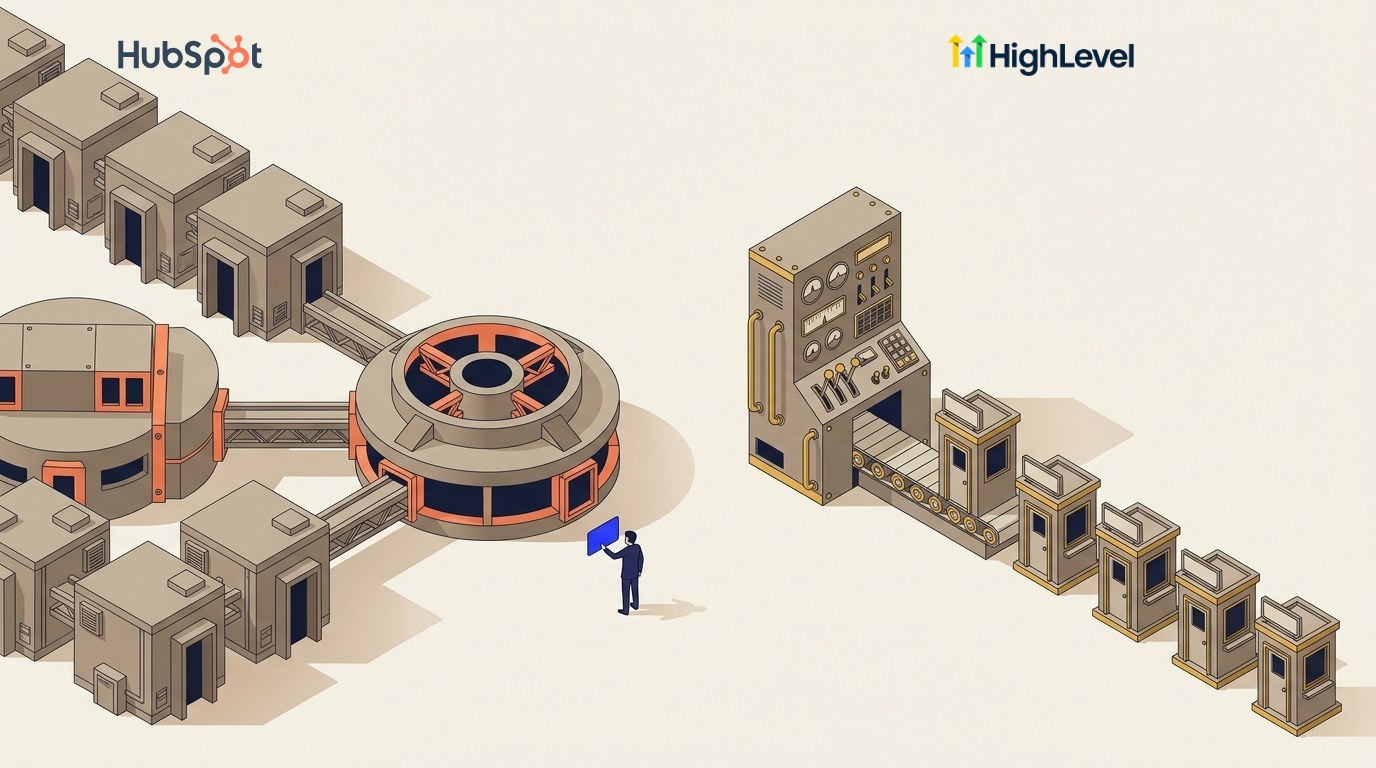
GoHighLevel and HubSpot rarely get shortlisted against each other for the reason people assume. They're not two CRMs competing for the same buyer: GoHighLevel is built for an agency running many client accounts under one roof, and HubSpot is built for one company's own sales, marketing and service teams sharing one database. This page reads both vendors' own pricing, plan and developer pages on the same day and lays out where each one is actually stronger, where each gets expensive, and what a team moving between them would need to know first.
The short version
- GoHighLevel charges a flat fee per account with unlimited users on every plan. HubSpot charges per seat. A 15-person HubSpot Sales Hub Professional team costs more in year one than GoHighLevel's top standard plan, however many people use it.
- GoHighLevel's core unit is the sub-account (one client or one business), not the seat. Its Starter plan caps that at 3 sub-accounts; Unlimited and Agency Pro remove the cap. HubSpot has no equivalent concept: one HubSpot account is one company.
- GoHighLevel's own documentation contradicts itself on webhook retries: one section of its help article says non-429 failures are "treated as final," another section on the same page says they now retry with exponential backoff for up to 3 days. Both statements are quoted below because the vendor hasn't resolved it.
- HubSpot's "24/7 support" and GoHighLevel's "24/7 Support" don't mean the same access. GoHighLevel's support button is only visible to Agency Admins and Agency Users; a sub-account user has to go through their agency, not HighLevel, for help.
- HubSpot goes further on data structure (custom objects, 1,000 custom fields per object, up to 1,000 workflows) and on published security detail. GoHighLevel goes further on white-label resale, SMS and voice built into the core product, and cost predictability at volume.
How this comparison was made
Every figure on this page was read on 29 September 2026 from a page the vendor itself publishes: pricing pages, help-centre articles, developer documentation and trust or compliance pages. Each table links the documents it came from, and the full list is at the bottom.
Salestruct isn't a partner, reseller or affiliate of either company, and nothing here is sponsored. We build sales systems on both, which is why the comparison is written around what a sales team does all week rather than around feature counts.
Five things to know before you read the numbers:
- Currencies don't match, and that's a finding, not an oversight. GoHighLevel's pricing page shows US dollars with no currency switch. HubSpot's pricing page showed euros to a visitor in the EU. Where both are quoted in the same row, the currency is stated every time.
- The pricing models aren't comparable seat for seat. GoHighLevel sells a flat monthly fee per account with unlimited users included; HubSpot sells per-seat pricing. A cost table that tried to plot both against "number of people" would misdescribe GoHighLevel, so the cost section below compares plan for plan instead.
- Plans compared. GoHighLevel Starter, Unlimited and Agency Pro (Enterprise is quote-only and excluded from the tables). HubSpot Sales Hub Free, Starter, Professional and Enterprise.
- GoHighLevel doesn't publish a marketplace app count. HubSpot states "over 2,000" and Pipedrive states "500+" on their own pages; GoHighLevel's marketplace has no published total, so the integrations section below counts unique listing URLs in GoHighLevel's own marketplace sitemap instead, and says so.
- "Not published" means we looked and the vendor doesn't say. It's a finding, not a gap we forgot to fill. Names and logos are trademarks of their owners, shown only to identify the products. No affiliation or endorsement is implied.
What is the difference between GoHighLevel and HubSpot?
GoHighLevel, built by HighLevel and founded in 2018 in Dallas, Texas by Shaun Clark, Varun Vairavan and Robin Alex, was built as a white-label platform for marketing agencies: one agency account can hold many "sub-accounts," each a separate client or business with its own CRM, funnels, calendars and phone numbers, and the agency can resell the whole thing under its own brand. HighLevel's own history page reports 1,000+ customers at its 2019 public launch, more than 60,000 by 2023 with $1B in customer revenue, and "2.2 million businesses" powered as of 2025, a figure that almost certainly counts sub-accounts rather than paying agency accounts, since GoHighLevel doesn't sell per-business seats.
HubSpot, founded in 2006, is a customer platform: separate products (Sales Hub, Marketing Hub, Service Hub, Content Hub, Data Hub, Revenue Hub) sold per seat on one shared CRM database, for one company's own team rather than for an agency managing other companies' accounts. HubSpot reports 9,000+ employees and 306,000 customers on its own "our story" page.
That difference in who the buyer is explains almost everything below. GoHighLevel's core unit is the sub-account, and its plans mostly scale by how many client accounts you run and how much you resell, not by headcount. HubSpot's core unit is the seat, and its plans scale by how many of your own people touch the system and which hub they need.
How much does GoHighLevel cost compared to HubSpot?
GoHighLevel charges one flat fee per account, in US dollars, with unlimited users included on every plan. HubSpot charges per seat, in euros, with a required one-time onboarding fee from Professional up. That structural difference matters more than which number is bigger: a 3-person GoHighLevel team and a 15-person GoHighLevel team on the same plan pay the identical monthly fee, while a HubSpot bill scales directly with headcount.
Plans and prices
Checked 29 September 2026

Pricing unit
Edge: Depends on your setup
Flat fee per account. Unlimited users included on every planPer seat, per monthFree option
Edge: HubSpot
No free plan. 14-day free trial, no long-term contract, on any planFree tools, up to 2 users, no card neededEntry plan
Edge: Depends on your setup
Starter: $97/month ($970/year). 3 sub-accountsStarter: €7 on the page, shown as a discount from €20 a seat. The page doesn’t say how long the discount lastsSecond plan
Edge: Depends on your setup
Comparable in name only. Unlimited buys unlimited client accounts for an agency; Professional buys deeper automation and reporting for one seat.
Unlimited: $297/month ($2,970/year). Unlimited sub-accounts, rebill phone and email with no markup, Basic APIProfessional: €90 per Sales SeatTop standard plan
Edge: Depends on your setup
Agency Pro: $497/month ($4,970/year). SaaS Mode, automated sub-account creation, rebill with markup, Advanced APIEnterprise: €150 per Sales SeatAbove that
Edge: Even
Enterprise: custom quote. Dedicated CSM, higher API limit on request, HIPAA included, white-label mobile app includedNo monthly price shown at Enterprise; sold through salesRequired one-time fee
Edge: GoHighLevel
None found on the pricing pageProfessional Onboarding €1,470Enterprise Onboarding €3,420
Contract terms
Edge: GoHighLevel
Month-to-month, cancel, upgrade or downgrade anytime, per the pricing page FAQStarter: monthly commitmentProfessional and Enterprise: sold on an annual commitment even when billed monthly
Usage-based extras
Edge: Depends on your setup
AI Employee Growth $50/mo, AI Employee Unlimited $97/mo, Premium Support $500/month, HIPAA $297/month, white-label mobile app $497/month, per sub-account or per account as markedHubSpot Credits for AI and some automation: 500, 3,000 or 5,000 included a month by tier, extra at $0.010 each, unused credits don’t roll overRead from: GoHighLevel pricing · HubSpot Sales Hub pricing · HubSpot price calculator.
The comparison that actually holds up is total account cost against total account cost, not seat against seat, because GoHighLevel doesn't sell seats. A 15-person team on GoHighLevel Agency Pro pays $497 a month whoever they are. The same 15 people on HubSpot Professional pay €16,200 a year in seats plus a €1,470 onboarding fee, before anyone adds a second hub. That gap is the entire case for GoHighLevel when the buyer is an agency scaling headcount, and it's also why GoHighLevel is the wrong tool to price by seat count in the first place: its add-ons (AI Employee, Premium Support, HIPAA, white-label mobile) are charged per sub-account or per account, so a GoHighLevel bill grows with how many client accounts and premium features you turn on, not with how many people log in.
Three pricing details neither vendor foregrounds on its main page:
- GoHighLevel's Workflow Pro Plan is a separate, usage-metered add-on, not part of the core plans above. It bills premium triggers, premium actions, marketplace apps and LC app executions on four tiers: Free ($0, 100 lifetime executions), Starter ($10/month, 10,000 executions), Growth ($25/month, 30,000), Scale ($50/month, 65,000), with overage from $0.01 down to $0.004 per execution and no rollover of unused executions.
- HubSpot's Starter price is a discount with no stated end. The calculator showed €84 a seat a year with €240 struck through, and the pricing page publishes no duration or renewal terms for the lower price. Budget for €240 unless your quote says otherwise.
- HIPAA on GoHighLevel is a one-way door. The $297/month add-on "cannot be canceled, refunded, removed, or downgraded once enabled," per HighLevel's own help article, and it applies to every location on the account, not just the ones that need it.
How do the interfaces compare?
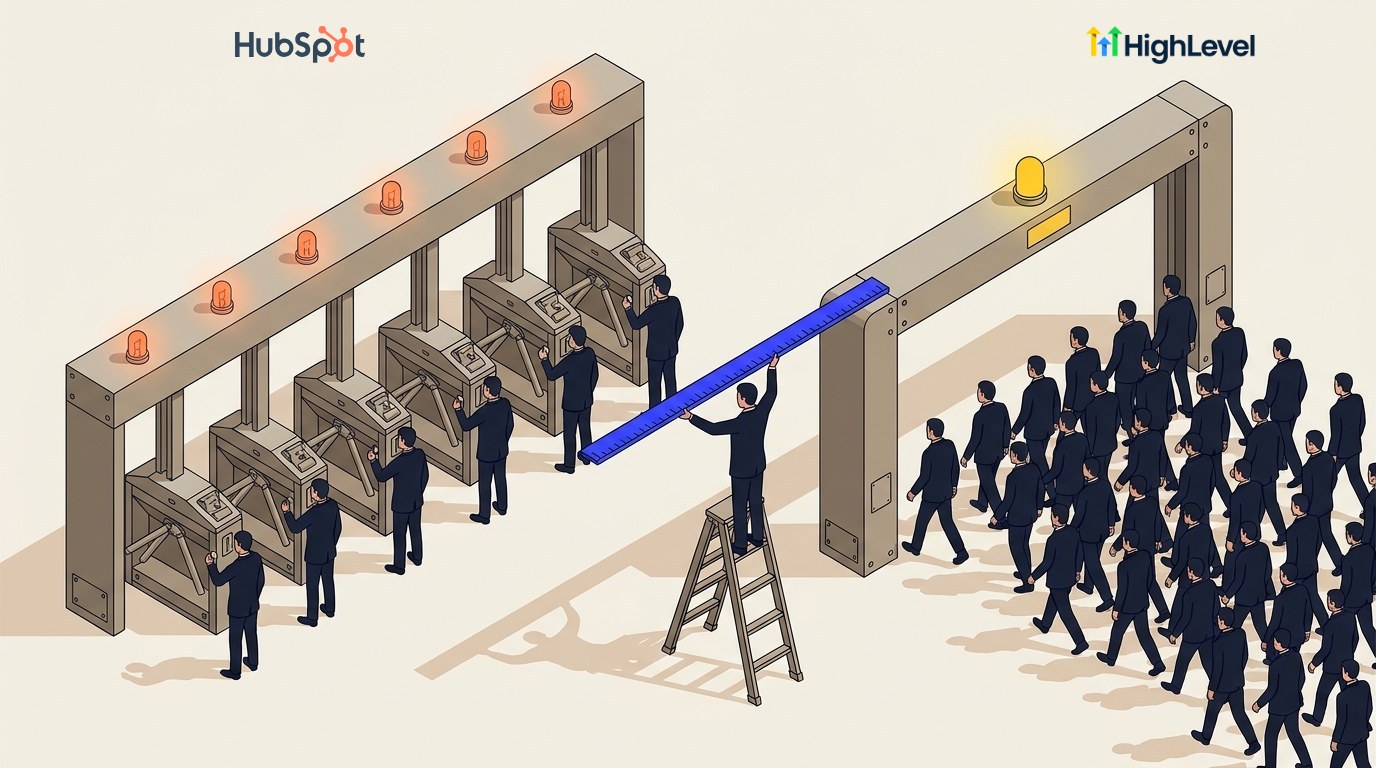
GoHighLevel's screen is organised around sub-accounts: an agency switches between client locations, and inside each one there's a CRM, a pipeline board, funnels and calendars. HubSpot's screen is organised around one company's own records, with a table view on every object and a board view for anything that has a pipeline.
Interface and account structure
Checked 29 September 2026Core unit of the account
Edge: Depends on your setup
The sub-account (a "location"): one client or business, with its own CRM, funnels, calendars and phone numbers, sitting under one agency loginThe seat: one person, working one shared set of company recordsManaging many client accounts
Edge: GoHighLevel
Built in. Agencies switch between sub-accounts from one login and can white-label the whole interfaceNot built for this. HubSpot is designed around one companyPipeline view
Edge: Even
Kanban-style opportunity pipeline per sub-account, the core screen for sales workTable view on every object, plus a board view where records move between stages as cards. All plansInternal access model
Edge: Depends on your setup
Two layers: User Type (Agency, full account access, or Account, restricted to specific sub-accounts) and Role (Admin or User), plus granular module permissionsPermission templates on Starter and Professional. Custom permission sets and field-level permissions on EnterpriseRead from: GoHighLevel agency sub-account explainer · GoHighLevel user roles and permissions · HubSpot board view · HubSpot record customisation.
Neither vendor publishes a usability measure or a comparable app-store rating split by product edition, so "easier to use" isn't something this page can settle. What's settled by the structure alone is who each interface is built for: an operator running other people's accounts, or a team running its own.
How do their data models and limits compare?
HubSpot gives more room per object and, on Enterprise, lets you build entirely new objects. GoHighLevel's data model is simpler and built around the sub-account rather than the object: contacts and users are unlimited on every plan, and the real ceiling is how many sub-accounts a plan allows.
Data model and account limits
Checked 29 September 2026Sub-accounts (clients)
Edge: Even
Starter: 3Unlimited and Agency Pro: unlimited
Not applicable. One HubSpot account is one companyContacts
Edge: Even
"Unlimited Contacts" on every planFree: 1,000 contacts. No cap stated for paid plansUsers
Edge: GoHighLevel
"Unlimited Users" on every plan, included in the flat feeSales Seats for reps, Core Seats for other users, each billed separatelyCustom objects
Edge: HubSpot
Not published as a feature of the platformEnterprise only: up to 10 object definitions and 1,000,000 custom object recordsCustom fields
Not covered in this reviewFree: 10 in totalPaid plans: 1,000 per object
Pipelines
Edge: HubSpot
One opportunity pipeline structure per sub-account, not published as a per-plan countFree: default pipeline onlyStarter: 15 custom
Professional: 100
Enterprise: 350
Read from: GoHighLevel pricing · HubSpot Product & Services Catalog · HubSpot pipelines.
The row worth sitting with is custom objects. HubSpot Enterprise lets you model something that isn't a contact, company or deal, such as a piece of equipment or a claim, and report on it the same way. GoHighLevel doesn't publish an equivalent, because its extensibility runs through custom fields on the objects it already has, not through new objects.
Which has better automation?
Both automate. GoHighLevel's workflow builder is included in the core plan and meters extra cost through a separate execution-based add-on for premium actions. HubSpot's workflow builder is priced by how many active workflows you run and adds code and AI steps at the top.
Workflows and automation
Checked 29 September 2026Workflow automation, base cost
Edge: Depends on your setup
Included in every core plan. Standard triggers and actions run at no extra chargeStarter: up to 50 workflows "with restricted triggers and actions"Professional: up to 300
Enterprise: up to 1,000
Premium action pricing
Edge: Depends on your setup
Separate Workflow Pro add-on: Free (100 lifetime executions), Starter $10/mo (10,000), Growth $25/mo (30,000), Scale $50/mo (65,000). Resets monthly, no rolloverIncluded in plan price up to the workflow count above, metered by HubSpot Credits for AI actions specificallyCode inside an automation
Edge: HubSpot
Not published as a featureJavaScript or Python (beta) custom code actions. Needs Data Hub Professional or EnterpriseAI inside an automation
Edge: Even
AI Employee features (Conversation AI, Voice AI) can be triggered from workflows as premium actionsAI actions in workflows on Professional and Enterprise, consuming HubSpot CreditsReselling automation to clients
Edge: GoHighLevel
Agencies can bulk-purchase Workflow Pro executions and rebill or mark them up to sub-accountsNot applicable. HubSpot has no client-reseller structureRead from: GoHighLevel Workflow Pro Plan pricing · HubSpot workflows · HubSpot custom code actions · HubSpot AI in workflows.
The two pricing models make direct comparison misleading if you only look at the sticker price. HubSpot bills automation by how many workflows are active, whatever they do. GoHighLevel bills its core workflows at zero and only starts charging once an execution touches something premium (an app, a marketplace integration, an LC app, or certain AI steps), so a simple internal automation can run for free indefinitely while a workflow that calls three integrations on every run burns through its execution allowance fast.
How do GoHighLevel and HubSpot webhooks compare?
Here the vendors disagree with themselves as much as with each other, and GoHighLevel's own documentation is the more striking case.
Webhooks
Checked 29 September 2026Retry on a 429 (rate-limited) response
Edge: GoHighLevel
Automatically re-sends the same payload up to 6 timesNot publishedRetry on other failures (4xx, 5xx)
Edge: Even
Both GoHighLevel statements are quoted directly from the same article, modified 10 July 2026. We could not resolve which one is current.
GoHighLevel's own help article contradicts itself. One section: "All other status codes... are treated as final" and "we do not retry on 5xx server errors." A later section on the same page: non-429 failures "now follow an exponential backoff retry strategy" and "retries can continue for up to 3 days"Not publishedProving the request is genuine
Not covered in this reviewSigned requests with SHA-256, currently v3 in the X-HubSpot-Signature-V3 headerWhere webhooks are configured
Per sub-account, and as an action inside a workflowEvent subscriptions in public and private apps, plus a webhook step in workflows on Data Hub Professional or EnterpriseRead from: GoHighLevel automated webhook retries · HubSpot request validation · HubSpot webhooks in workflows.
If you're building an integration on GoHighLevel webhooks, don't design around either version of that retry policy alone. Build your endpoint to be idempotent (safe to receive the same event twice) and add a scheduled API check as a backstop for anything that must not be missed, exactly as we'd recommend on a vendor whose own documentation hasn't settled the question.
How do their APIs compare?
Both publish a REST API with rate limits stated per time window. GoHighLevel counts requests per app per location; HubSpot counts requests per app and adds a separate daily cap by plan.
API access and limits
Checked 29 September 2026API access by plan
Edge: Even
Basic API on Starter and Unlimited. Advanced API on Agency Pro. Higher limits available on request for EnterprisePrivate apps on every plan including FreeBurst limit
Edge: Even
100 requests per 10 seconds, per Marketplace app, per location100 requests per 10 seconds on Free and Starter, 190 on Professional and EnterpriseDaily limit
Edge: HubSpot
200,000 requests per day, per app, per locationFree and Starter: 250,000. Professional: 625,000 (HubSpot’s own product catalog says 650,000, an internal disagreement). Enterprise: 1,000,000Versioning
Edge: Even
V1 APIs reached end-of-support 31 December 2025. Current documentation lives on a separate developer portalDate-versioned APIs, such as 2026-09Bulk import
Not covered in this review80,000,000 rows a day. Files up to 1,048,576 rows or 512 MB. Three imports at a timeRead from: GoHighLevel API documentation · HubSpot API usage guidelines · HubSpot Product & Services Catalog · HubSpot imports API.
GoHighLevel's limit is per app per location, which matters for an agency: the same integration hitting 50 sub-accounts effectively gets 50 separate 200,000-a-day allowances, one per location, rather than one shared pool. HubSpot's limit is per account regardless of how many objects or hubs that account touches.
Which has more integrations?
This is the one section where the two vendors don't even publish comparable numbers, so the method has to be stated plainly.
Integrations
Checked 29 September 2026Marketplace size
Edge: Depends on your setup
Not a like-for-like count: ours is a sitemap count for GoHighLevel, a vendor claim for HubSpot.
1,313 unique listing URLs counted in GoHighLevel's own marketplace sitemap on 29 September 2026. GoHighLevel doesn't publish an official total"Over 2,000" apps, stated on HubSpot's own marketplace pageNo-code automation tools
Edge: HubSpot
n8n has built-in nodes for creating, updating and deleting HighLevel contacts, opportunities and tasks, and for booking appointments and reading free calendar slots. Zapier's LeadConnector integration ships 1 trigger and 5 actions, with no search actionsZapier, Make and n8n all connectPayments
Edge: Even
Built-in payments and invoicing, per the core feature list, plus Stripe, PayPal, NMI, Authorize.net, Square, Adyen and Razorpay as connected payment providersQuickBooks, Xero and Stripe, all plansRebilling to clients
Edge: GoHighLevel
Rebill phone and email usage to sub-accounts on Unlimited (no markup) and Agency Pro (with markup), built into the core productNot applicable. HubSpot has no sub-account or rebilling modelRead from: GoHighLevel marketplace · GoHighLevel marketplace sitemap · n8n HighLevel integration · GoHighLevel pricing (payment providers) · HubSpot marketplace.
Marketplace size is a weak signal on either side of this comparison, but for a different reason on each. HubSpot's "over 2,000" is a vendor claim we can't independently verify without crawling its own marketplace the same way. GoHighLevel's 1,313 is a floor, not a vendor claim: it's every unique listing page the public sitemap lists today, and it will undercount anything the sitemap doesn't expose as its own page.
How do reporting and AI features compare?
HubSpot's reporting is deeper and gated mostly by plan tier. GoHighLevel's dashboards are included from Starter, and its AI suite is the more unusual part of the product: five named AI features, three plan tiers of AI pricing, and per-feature usage limits that sit outside the core plan price entirely.
Reporting and AI
Checked 29 September 2026Dashboards and reporting
Edge: HubSpot
Custom Dashboards & Reporting listed as a core feature on every plan, per-plan report limits not publishedFree 10, Starter 30, Professional 75, Enterprise 100 dashboards. Custom reports from ProfessionalAI feature set
Edge: Even
Conversation AI, Voice AI, Content AI, Funnel AI and Reviews AI, plus Ask AI and Agent StudioProspecting agent, Agent Builder and AI actions in workflowsHow AI is priced
Edge: Depends on your setup
Three tracks: Pay-Per-Use (token cost only), AI Employee Growth ($50/month per location, 1,000 Conversation AI responses, 100 Voice AI minutes included), AI Employee Unlimited ($97/month per location, unlimited Conversation AI and Voice AI)HubSpot Credits: 500, 3,000 or 5,000 included a month by tier, extra at $0.010 each, no rolloverFree AI usage
Funnel AI, Workflow AI and Email AI are free on every track, including Pay-Per-UseNot covered in this reviewFair use limits
Free and unlimited usage is subject to a fair-use policy; HighLevel can throttle, limit or require an upgrade for excessive useNot publishedRead from: GoHighLevel AI product pricing · GoHighLevel pricing (core feature list) · HubSpot pricing plan table · HubSpot Credits.
The AI Employee Unlimited plan is the detail worth doing the math on before you buy it. At $97 a month per location, an agency running AI Employee Unlimited across 20 sub-accounts is paying $1,940 a month in AI add-ons alone, on top of whichever core plan it's already paying for.
How do security, hosting and support compare?
Both publish SOC 2 Type II certification. Where they diverge is on hosting transparency and, more sharply, on who's actually allowed to open a support ticket.
Security, hosting and support
Checked 29 September 2026Certifications
Edge: Even
SOC 2 Type II, accredited on Security, Confidentiality and Availability, per HighLevel's own announcementSOC 2 Type II (report under NDA). HubSpot states it is not ISO 27001 certifiedWhere data is hosted
Edge: HubSpot
Google Cloud Platform and AWS. "Product infrastructure resides in the United States." No specific region or EU option publishedEU data centre since July 2021Uptime target
Edge: HubSpot
Not published by HighLevel directly. Cites Google's and AWS's own guarantees (99.5% and 99.95% to 100%) for the infrastructure it runs on99.95% monthly uptime target, "commercially reasonable efforts"HIPAA
Optional add-on, $297/month, account-wide, "cannot be disabled once purchased." Included at no extra cost on EnterpriseNot covered in this reviewWho can reach support
Edge: HubSpot
Only Agency Admins and Agency Users see the support button and can open a ticket. Sub-account (client) users must go through their own agency, not HighLevel, per HighLevel's own support articleStarter: chat and email. Professional and Enterprise: adds phone. Newer accounts need a paid seat to contact supportPaid support upgrade
Edge: Even
Premium Support: $500/month add-onPremium Support with 1-hour response: paid Enterprise add-onRead from: GoHighLevel security and compliance overview · GoHighLevel SOC 2 Type II announcement · GoHighLevel HIPAA compliance · GoHighLevel 24/7 support options · GoHighLevel pricing (Premium Support, HIPAA) · HubSpot Trust Center · HubSpot support options.
The support row is the one to read twice if you're a sub-account user rather than the agency owner. GoHighLevel's pricing page advertises "24/7 Support" on every plan, and that's true for the agency. If you're a client sitting inside someone else's GoHighLevel account, the support button isn't there for you at all; you raise it with your agency, and your agency raises it with HighLevel.
Where each one is weaker
Every product loses somewhere. These are the limits each vendor's own documents show, stated with the same weight as the strengths above.
GoHighLevel's weak points
- No custom objects, and no published per-plan limit on pipelines, custom fields or dashboards, which makes it harder to plan capacity in advance.
- Its own webhook documentation contradicts itself on retry behaviour, and neither version has been confirmed as current.
- Support access is gated by agency role. A sub-account user cannot open a ticket directly with HighLevel.
- HIPAA, once purchased, cannot be turned off, downgraded, cancelled or refunded, and it applies account-wide.
- No published marketplace total, no EU hosting region, and no independent signature scheme published for webhooks.
- Standard workflows are included, but anything that touches a premium action, a marketplace app or certain AI steps draws down a separate, metered Workflow Pro allowance that can run out mid-month.
HubSpot's weak points
- It costs more per person at every comparable tier, and Professional and Enterprise carry a required onboarding fee of €1,470 or €3,420.
- No agency or sub-account structure at all, so a business managing other businesses' accounts has to run separate HubSpot instances for each one.
- Custom objects, custom permission sets and field-level permissions are Enterprise only.
- Most AI runs on credits that reset monthly, and the Starter discount has no published end date.
- Daily API capacity disagrees with itself between HubSpot's own developer guidelines (625,000 on Professional) and its Product & Services Catalog (650,000).
- No built-in white-label resale, SMS carrier, or voice system comparable to what GoHighLevel bundles into its core plans.
GoHighLevel or HubSpot: which should you choose?
These two rarely serve the same buyer, so the table below is less "which is better" and more "which one is even the right category for you."
| If your team... | Lean towards | Because |
|---|---|---|
| Is an agency running many client accounts under one roof | GoHighLevel Unlimited or Agency Pro | Unlimited sub-accounts, unlimited users, built-in white-label resale and rebilling |
| Is one company's own sales, marketing and service team | HubSpot | No sub-account model exists on GoHighLevel; HubSpot is built for one shared database |
| Needs to model something that isn't a contact, company or deal | HubSpot Enterprise | Custom objects. GoHighLevel doesn't publish an equivalent |
| Wants SMS, voice, funnels and a CRM in one flat-fee product | GoHighLevel | All included in the core plan; on HubSpot most of this needs Marketing or Service Hub |
| Has more than a handful of people who'll need seats | GoHighLevel | Unlimited users on every plan versus HubSpot's per-seat pricing |
| Needs deep, code-level automation with signed webhooks | HubSpot, with Data Hub | Custom code and AI steps in workflows, published signature scheme |
| Handles PHI and needs HIPAA support | Either, with care | GoHighLevel: $297/month add-on that can't be turned off once bought. HubSpot: not covered in this review, check directly before assuming coverage |
| Needs a support line the end client can call directly | HubSpot | GoHighLevel gates support access to Agency Admins and Users |
If the table points to GoHighLevel because of the buyer, but to HubSpot because of the depth you need, that usually means the real question is what your sales process should look like before either tool gets configured.
Sources
GoHighLevel, Pricing page, USD, read 29 September 2026. Plan prices, core features, add-ons, contract terms, payment providers (2026)
GoHighLevel, About HighLevel: company history, founding year, customer milestones 2018 to 2025 (2026)
GoHighLevel, What is an Agency Sub-Account in HighLevel, last updated 19 May 2026 (2026)
All 29 sources and how they were checked
GoHighLevel, How to manage agency user roles and permissions, last updated 18 September 2026 (2026)
GoHighLevel, Workflows Pro Plan, new pricing tiers, modified 4 September 2025 (2025)
GoHighLevel, Automated webhook retries, modified 10 July 2026. Contains the retry-policy self-contradiction quoted above (2026)
GoHighLevel, HighLevel API documentation, modified 18 August 2026. Rate limits, API access by plan (2026)
GoHighLevel, AI Product Pricing, modified 28 September 2026. Pay-Per-Use, AI Employee Growth and Unlimited plans (2026)
GoHighLevel, HighLevel security and compliance overview, modified 16 June 2026. Hosting on GCP and AWS (2026)
GoHighLevel, HighLevel achieves SOC 2 Type II certification, modified 11 March 2026 (2026)
GoHighLevel, HIPAA compliance with HighLevel, modified 11 June 2026. $297/month add-on terms (2026)
GoHighLevel, 24/7 customer support options, modified 3 August 2026. Agency-gated support access (2026)
GoHighLevel, Marketplace, and its sitemap of 1,313 unique listing URLs, counted 29 September 2026 (2026)
n8n, HighLevel integration and node documentation (2026)
HubSpot, Sales Hub pricing and plan table, EUR, read 29 September 2026 (2026)
HubSpot, Create a Bundle price calculator, read 29 September 2026 (2026)
HubSpot, Product & Services Catalog. Per-tier limits and the 650,000-call daily figure (2026)
HubSpot, Set up and manage object pipelines, last updated 29 September 2026 (2026)
HubSpot, Create workflows, last updated 25 September 2026 (2026)
HubSpot, Use webhooks with HubSpot workflows, last updated 16 September 2026 (2026)
HubSpot, Custom code workflow actions, developer documentation (2026)
HubSpot, Use AI assistants in workflows, last updated 25 September 2026 (2026)
HubSpot, API usage guidelines and limits, last modified 31 August 2026 (2026)
HubSpot, Imports API guide (2026)
HubSpot, Understand how to use HubSpot Credits, last updated 2 July 2026 (2026)
HubSpot, Trust Center: SOC 2 Type II, ISO 27001 answer, EU data centre, 99.95% uptime (2026)
HubSpot, Get help with HubSpot, last updated 15 September 2026. Support by plan (2026)
HubSpot, Our story. Founding year, employees, customers (2026)
HubSpot, App marketplace, read 29 September 2026 (2026)
Every figure on this page was read from the vendor's own page on 29 September 2026 and is linked above. Prices change often; if a number here disagrees with the vendor's page on the day you read it, the vendor's page is right. Salestruct has no commercial relationship with GoHighLevel or HubSpot.
Common questions
If you want a second pair of eyes on your own setup, Salestruct runs a free diagnostic.
Read next.
All articlesHubSpot vs Pipedrive: which CRM for a sales team?
Every plan, limit and price, read from each vendor's own pages on 29 September 2026: interface, automation, webhooks, API, integrations, AI, security, support and year-one cost at 5 and 15 seats.
HubSpot vs Salesforce: real cost at 10, 25 and 50 seats
Every plan, add-on and limit, read from each vendor's own pages on 29 September 2026: licences, required extras, automation limits, AI credits and the real year-one bill at 10, 25 and 50 seats.